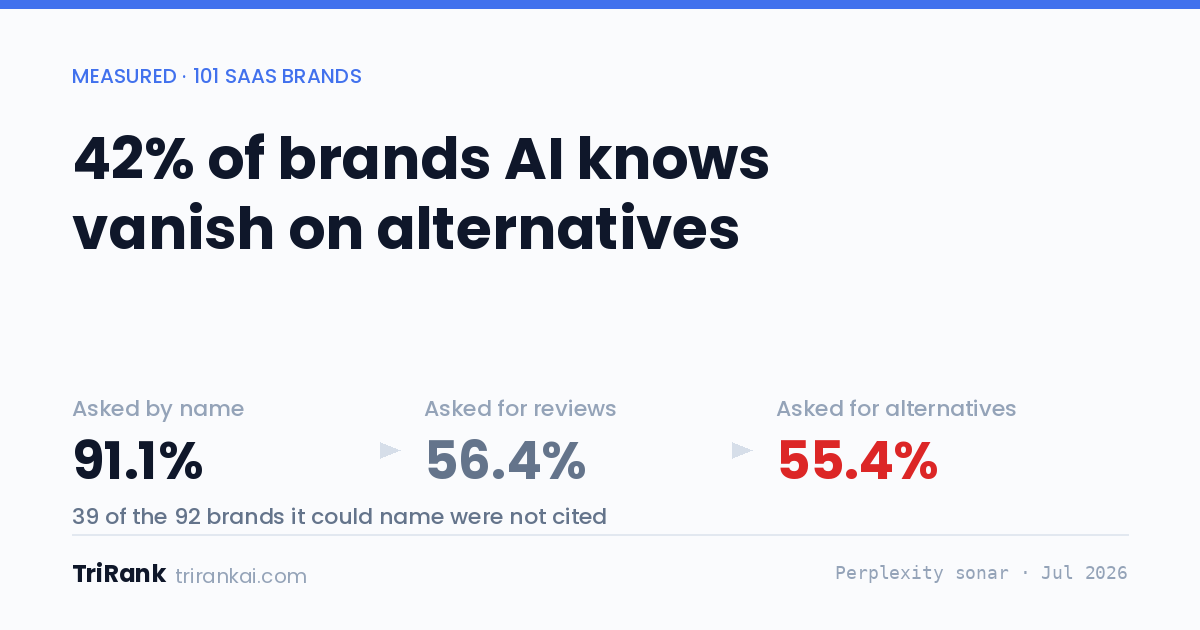
42% of Brands AI Knows By Name Vanish When You Ask for Alternatives
AI engines name 91% of SaaS brands asked directly. Ask the same engine for alternatives in that category and 42% of them disappear. Measured across 101 brands.
本文目前只有英文版。站点其余部分已汉化,这篇内容尚未翻译。
There are two ways to be invisible in AI search. The obvious one is that the engine has never heard of you. The expensive one is that it knows exactly who you are, and still does not mention you when a buyer asks the question that matters.
We measured the second one.
The measurement
101 well-known SaaS brands, three questions each, run on Perplexity (sonar) in July 2026. The three questions escalate in commercial intent:
| Question type | Brands cited | Rate |
|---|---|---|
| Asked about the brand by name | 92 of 101 | 91.1% |
| Asked for reviews of the brand | 57 of 101 | 56.4% |
| Asked for alternatives in its category | 56 of 101 | 55.4% |
Across the full run there were 2,469 citations. A brand counts as cited only when its own domain appears in the engine's structured citation list — being mentioned in the prose without a link does not count. That is a strict rule and we keep it strict, because a mention you cannot verify is not a measurement.
The number that matters
The interesting figure is not 55.4%. It is what happens to the brands the engine already knows.
Of the 92 brands cited on their own name, 39 were not cited when the same engine was asked for alternatives in their category. That is 42.4%.
The denominator is 92, not 101. This is deliberate and it changes the number: we are not counting brands the engine has never heard of, because "unknown brand stays unknown" is not interesting. We are counting brands with demonstrated presence that fail to convert it. Use 101 as the denominator and you get a different, softer figure that describes something else.
Put plainly: for four brands in ten, the engine can tell you all about them and will not bring them up when a buyer is choosing.
Where the alternatives answer comes from instead
The gap has a mechanical explanation, and our source data shows it.
Ask about a brand and the engine retrieves pages about that brand — press, docs, the company's own site. Ask for alternatives and it retrieves a different shelf entirely: roundups, comparison pages, and community threads. You appear there only if somebody else put you there.
Here is what the engine actually cited on alternatives prompts, versus reviews prompts:
| Source | Share on alternatives | Share on reviews |
|---|---|---|
| 11.0% | 11.4% | |
| YouTube | 4.8% | 10.7% |
| G2 | 2.3% | 7.5% |
| Trustpilot | — | 8.7% |
Two things stand out. Reddit is the single largest source in both slots — it appeared for 98 of the 101 brands across the whole run. And review platforms shrink sharply on alternatives queries: G2 drops from 7.5% to 2.3%, Trustpilot falls out of the top five entirely. The place where buyers compare options is not the place vendors have been optimising.
Across the entire run, brands' own domains accounted for 10.2% of all citations. Roughly nine citations in ten pointed somewhere else.
Not every category loses equally
The same benchmark breaks down by category. The alternatives rate — the share of category brands cited when the engine is asked for alternatives — ranges from total to zero:
| Category | Brands | Cited on alternatives |
|---|---|---|
| Analytics | 5 | 80% |
| Knowledge base | 5 | 80% |
| Monitoring | 5 | 80% |
| Forms | 4 | 75% |
| Project management | 9 | 67% |
| HR | 9 | 56% |
| CRM | 9 | 56% |
| Design | 6 | 50% |
| Dev platform | 4 | 50% |
| Productivity | 6 | 33% |
| Automation | 4 | 25% |
| Finance | 5 | 20% |
| Video | 5 | 0% |
Video tools were cited on their own names 80% of the time and on alternatives queries not once. Whatever comparison content exists in that category, the engine is not reaching for these brands when it writes it.
Two limits on this table. It shows 13 of 23 categories — the other ten had fewer than four brands sampled and were held back rather than published thin. And the smallest categories here have four brands, so treat those rows as a signal to check, not an industry conclusion.
What this changes about how you check
Most visibility checks ask the engine about the brand. That question has a 91% pass rate and tells you almost nothing.
The question worth asking is the one your buyer asks: what are the best tools for X, alternatives to Y, X vs Y. If you want to run that manually, the method is in how to check if ChatGPT cites your website. If you want the metric definitions behind it — citation frequency, share of voice, mention versus source — those are in AI search visibility metrics and KPIs.
The mechanics of being included in that second shelf are a different job from ranking, and we wrote the eight-step version in how to get cited by ChatGPT. If you are tracking mentions rather than citations today, how to track brand mentions in AI search covers why those two things diverge, and citation tracking in Perplexity and ChatGPT covers doing it per engine.
For definitions: AI citations, brand mentions in AI, AI search visibility, and search intent — because the whole finding above is an intent story.
The boundaries of this data
One engine, one month, 101 brands, three prompts each. Perplexity returns structured citations, which is why this is measurable; other engines behave differently and we do not claim otherwise. The July 2026 collection date is stamped on every figure. And "cited" means the domain appeared in the structured citation list — the strictest available reading, chosen so the number cannot be inflated by mentions we cannot verify.
The full breakdown, including the source tables, is on the benchmark page and the citation sources page.
FAQ
What does the 42% actually measure? Of the 92 brands an engine could cite when asked about them by name, 39 were not cited when the same engine was asked for alternatives in their category. That is 42.4%. The denominator is 92, not 101 — it only counts brands the engine demonstrably knows.
Why does a brand disappear on an alternatives query? A brand query retrieves pages about that brand, which usually includes its own site. An alternatives query retrieves comparison and community content, where the brand only appears if someone else put it there. In our data, Reddit alone accounted for 11.0% of citations on alternatives prompts.
Which categories lose the most brands on alternatives queries? In our July 2026 run, video tools were cited on alternatives prompts 0% of the time, finance tools 20%, automation 25% and productivity 33% — against analytics and knowledge-base tools at 80%.
与本文相关的免费工具
更多文章
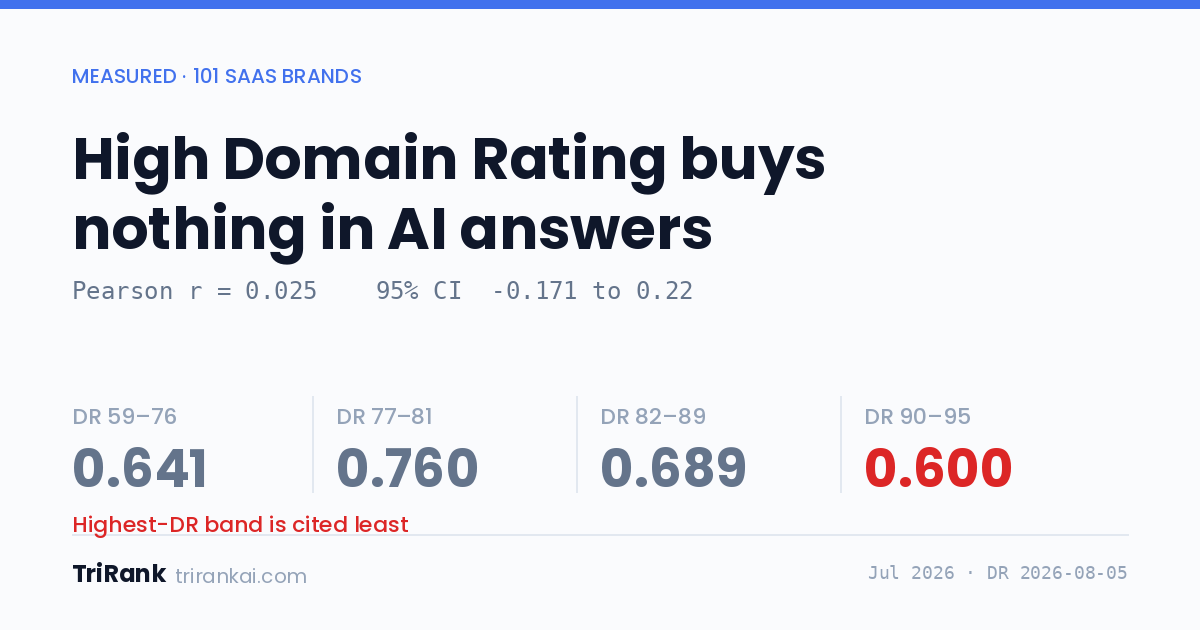
High Domain Rating Buys You Nothing in AI Answers
We crossed Ahrefs Domain Rating with AI citation rates for 101 SaaS brands. The highest-DR band is cited least often. Here is the data and its limits.

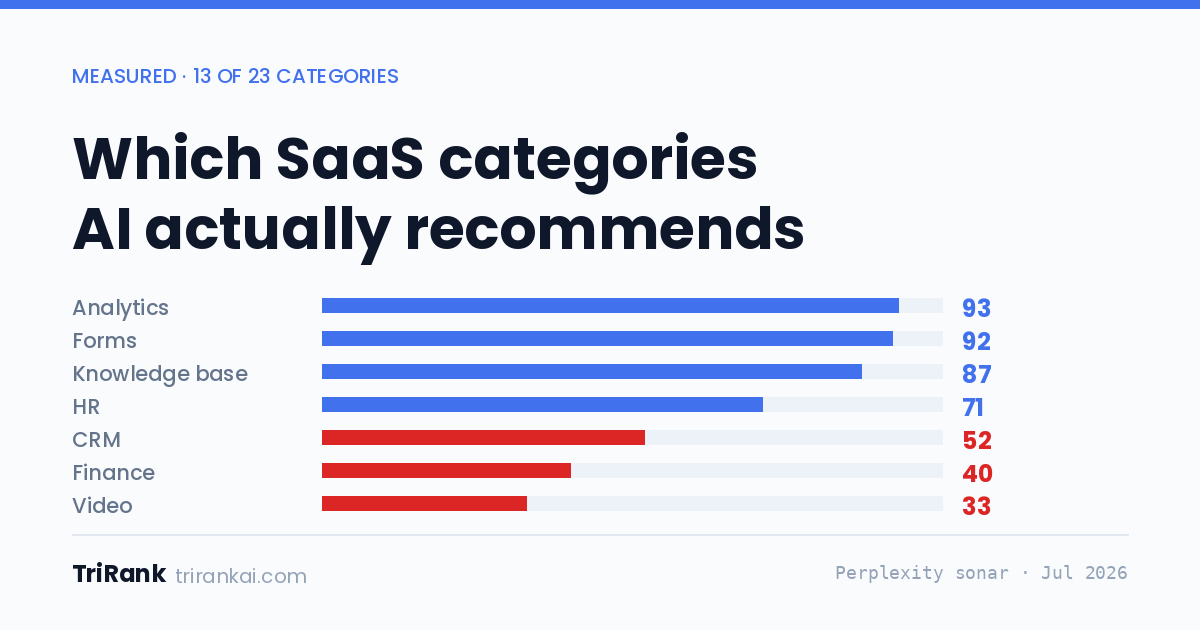
Which SaaS Categories AI Actually Recommends (13 Categories, Measured)
Analytics tools score 93 out of 100 on AI visibility. Video tools score 33. We measured 13 SaaS categories on the same three questions in July 2026.
Why Ranking #1 on Google Doesn't Get You Cited by AI (833 Keywords, 831 Never Checked)
A site we own ranked on page one for 833 Google keywords as of 2026-08-12 — and 831 of them had never been checked against a single AI engine. Why Google rankings don't transfer to AI answers, and why 'not cited' and 'not checked' are different findings.
邮件列表
加入我们的社区
订阅邮件列表,及时获取最新消息和更新