Answer Engine Optimization (AEO): What Is AEO?
Answer engine optimization (AEO) shapes content so AI engines extract and surface it. Definition, AEO vs GEO and SEO, tactics, and how to measure.
本文目前只有英文版。站点其余部分已汉化,这篇内容尚未翻译。
Answer Engine Optimization (AEO): What Is AEO?
Answer engine optimization (AEO) is the practice of structuring content so that AI-powered answer engines can extract, trust, and surface it directly in their responses. Where classic SEO optimizes to rank a page in a list of links, AEO optimizes to have a specific passage lifted into an answer, whether that answer appears in Google's AI Overviews, ChatGPT, Perplexity, or a featured snippet. The unit of optimization shifts from the page to the passage.
This shift is not speculative. AI Overviews now appear on roughly 25.11% of searches, with an average coverage of 34.5% and a peak of 47% across categories (Conductor), and they are triggered by 60% of question queries (Pew). Answer engines are where a growing share of queries resolve, often without a click. Optimizing for them is the discipline this post covers: what AEO is, how it differs from GEO and from SEO, how engines actually extract answers, the tactics that work, and how to measure results.
What is AEO?
Answer engine optimization (AEO) is the practice of formatting and structuring content so AI answer engines can pull a direct answer from it and present that answer to a user. The goal is not a high-ranking link; it is being the source the engine quotes, summarizes, or cites when it composes a response.
The discipline exists because user behavior moved. A large and growing share of searches now end inside the answer rather than on a destination page. Zero-click searches sit at 58.5% (SuperPrompt), and 93% of AI Overview appearances result in no click to the underlying source (Semrush, Sep 2025). If the answer is delivered in the results surface, the competitive question is no longer "does my page rank?" but "is my content the one the engine drew the answer from?" That is the question AEO answers.
AEO is also where the industry is investing fastest. AEO-related activity has grown roughly 2000% year over year (G2), and 97% of marketers report AEO has had a positive effect (Conductor). The attention is rational: answer engines are intercepting queries upstream of the click, and the brands shaping their content to be extractable are the ones still being seen. For the formal definition, see our answer engine optimization glossary entry.
AEO vs GEO
AEO and GEO overlap but optimize for different outputs: AEO targets extractable direct answers, including featured snippets and AI Overviews, while generative engine optimization (GEO) targets being cited and synthesized inside fully generative responses from engines like ChatGPT, Perplexity, and Gemini. AEO is the older, answer-box-rooted discipline; GEO is its extension into models that compose rather than extract.
The practical difference is in the unit of success. AEO succeeds when an engine lifts a clean, self-contained passage from your page and presents it as the answer. That favors content with crisp, directly-stated answers that survive being pulled out of context. GEO succeeds when a model weaves your brand or content into a synthesized, multi-source response, which favors authority signals, original data, and a wide mention footprint across the web. The two share a foundation, structured, extractable, trustworthy content, but they diverge in emphasis.
In practice you are not choosing between them. The same content investments, answer-first structure, original data, clean formatting, feed both. The reason to keep the distinction in mind is measurement: a featured-snippet win is an AEO outcome, a citation inside a ChatGPT response is a GEO outcome, and conflating them obscures which surface is actually driving visibility. For a full treatment of the generative side, see our guide to generative engine optimization.
How AI extracts answers
AI answer engines extract answers by parsing content into chunks or passages and selecting the segment that most directly and completely answers the query, which is why where an answer sits on the page matters enormously. Engines do not read a page as a single block; they break it into retrievable segments and score those segments for relevance and self-containment. A passage that states its answer plainly and early is far more likely to be selected than one that buries the conclusion.
The positional data is decisive. An estimated 44.2% of citations come from the first 30% of a page's content (Growth Memo, Feb 2026). Nearly half of all citations are won in the opening third. The implication for structure is direct: front-load the answer. State the conclusion in the first sentence under each heading, then support it. Content that makes the engine read to the bottom to find the answer is content that loses to content that states it up front.
What gets extracted is also a function of substance, not just position. Passages carrying original data are cited disproportionately: 52.2% of cited passages contain original statistics or data (Search Engine Land), and adding statistics, quotes, and structured data lifts AI visibility by roughly 40% (Princeton and Georgia Tech). The extraction model rewards passages that are both well-positioned and information-dense. The optimization, then, is a passage that appears early, answers directly, and carries a concrete fact the engine can attribute. The underlying mechanism is retrieval, and our retrieval-augmented generation glossary entry covers how engines fetch and ground their answers.
AEO tactics
The core AEO tactics are answer-first structure, schema markup, and dedicated FAQ formatting, each aimed at making your content easier for an engine to parse, trust, and lift. None of them is exotic; the discipline is in applying them consistently so every passage is a candidate for extraction.
Answer-first structure is the highest-leverage tactic, because it aligns directly with how engines extract. State the answer in the first sentence under each heading, then elaborate. Given that 44.2% of citations come from the first 30% of content (Growth Memo, Feb 2026), placing the answer up front is not stylistic preference; it is the single change most likely to move extraction rates. Pair it with original data in the same passage, since 52.2% of cited passages carry original statistics (Search Engine Land).
FAQ formatting maps content to the question-shaped queries that dominate answer engines. With 60% of question queries triggering an AI Overview (Pew), structuring content as explicit question-and-answer pairs gives engines clean, self-contained units to extract. Each FAQ answer should open with the direct answer and stay short enough to be lifted whole. A free FAQ generator drafts those pairs with FAQPage schema to start from. See our people also ask glossary entry for how question clusters surface.
Schema markup is the tactic most often misrepresented, and it deserves an honest treatment, below.
| AEO tactic | What it does | Strength of evidence |
|---|---|---|
| Answer-first structure | Places the answer where engines extract (first 30%) | Strong: 44.2% of citations from first 30% |
| Original data in passages | Makes passages citation-worthy | Strong: 52.2% of cited passages carry data |
| FAQ formatting | Matches question-shaped queries | Strong: 60% of question queries trigger AIO |
| Schema markup | Aids parsing and eligibility | Indirect: no significant direct citation effect |
Does schema help AEO? An honest answer
Schema markup does not appear to directly cause more AI citations, but it still aids parsing and eligibility, so it remains worth implementing. This is the honest version, and it differs from much of the advice circulating about AEO. Per Ahrefs' analysis, schema markup had no significant direct effect on AI citations. Adding schema is not a lever that, on its own, makes an engine cite you more.
That finding should change how you prioritize, not whether you implement. Schema still helps engines correctly parse and classify your content — the same semantic SEO work of making meaning explicit rather than implied — and it governs eligibility for structured results like featured snippets and rich results that feed answer surfaces. It is plumbing, not propulsion: it makes your content cleanly machine-readable and eligible, which is necessary, but it does not substitute for the things that actually drive citation, answer-first structure, original data, and a strong mention footprint.
So the practical guidance is calm and clear. Implement schema because it supports parsing and keeps you eligible for the surfaces that matter, but do not expect it to move citation rates by itself, and do not spend the time you would have spent on answer-first restructuring and original data on schema instead. Our schema markup glossary entry covers implementation, and featured snippet covers the surface schema most directly affects. A free schema markup generator builds valid JSON-LD for a given type, so the required properties are complete before you add it.
AEO vs SEO
AEO and SEO share a foundation but optimize for different endpoints: SEO optimizes a page to rank in a list of links, while AEO optimizes a passage to be extracted into a direct answer. SEO's success metric is position; AEO's is whether your content becomes the answer. The two are complementary, not competing, because the content quality, crawlability, and authority that SEO builds are also what makes content extractable.
The reason AEO has become a distinct discipline is that ranking and being-the-answer have decoupled. A page can rank first and still lose the click, because the answer is delivered above it. When an AI Overview appears, click-through rate to the #1 organic result falls by 58% (Ahrefs), and 93% of AI Overview appearances yield no click at all (Semrush, Sep 2025). Gartner projects a 25% decline in traditional search volume by 2026 (Gartner). Ranking still matters, but it no longer guarantees visibility the way it once did.
The right framing is additive. Keep doing SEO, crawlability, authority, intent matching, because it is the substrate AEO builds on, and layer AEO on top so your already-ranking content is also structured to be extracted. For a deeper comparison, see AEO vs SEO, and our AEO vs SEO glossary entry for the concise definitions.
Measuring AEO
Measure AEO by tracking how often your content is extracted into answer surfaces, featured snippets, AI Overviews, and AI-engine citations, rather than by tracking rank alone. Position is no longer a proxy for visibility once answers are delivered above the links, so an AEO measurement program watches extraction and citation directly.
The metrics that matter are citation frequency (how often you are surfaced), the mix of answer surfaces you appear on, and consistency across engines, since results fragment heavily, with 91% of citations appearing on a single engine (Growth Memo, May 2026). Because citation sets also change 40-60% month over month (Ahrefs), AEO measurement has to be continuous; a one-time check cannot distinguish a real gain from churn. This is where TriRank fits: its watchlist runs continuous AI-citation monitoring across the three-engine model, its reports run on real Google Search Console data with a monthly archive so you can see extraction trends over time, and its citation-source analysis shows whether a cited passage came from your domain or a third party. For the full metric framework, see AI search visibility metrics and KPIs.
Once measurement is in place, the optimization loop is simple: identify the question queries where you should be the answer but are not, restructure those passages answer-first with original data, and watch extraction rates over the following weeks. For a tactical playbook on earning citations specifically from ChatGPT, see get cited by ChatGPT playbook.
Want to know which of your pages are being extracted into AI answers and which are invisible? Run a free audit to see your AEO standing across all three engines.
Common AEO mistakes
The most common AEO mistake is burying the answer, because an engine cannot extract a passage that does not exist as a clean, self-contained statement near the top of the section. Pages that open with a throat-clearing introduction and only reach the answer in paragraph four are structurally disadvantaged: with 44.2% of citations drawn from the first 30% of a page (Growth Memo, February 2026), an answer placed late is an answer rarely lifted. The fix is mechanical — lead each section with a one-sentence answer, then elaborate beneath it.
A second mistake is optimizing only for queries that never trigger an answer at all. AEO pays off most on question-shaped and longer queries, where roughly 60% of question queries surface an AI Overview (Pew Research), so the highest-leverage targets are the explanatory questions your buyers actually ask rather than short navigational terms. Mapping content to question keywords and real search intent is what separates AEO effort that compounds from effort that lands on queries no engine summarizes.
A third mistake is treating AEO as a one-time formatting pass. Because answers are increasingly resolved on the results page itself — zero-click searches now account for 58.5% of all Google queries (SuperPrompt) — the cost of being absent from the answer is rising, and the answer sets themselves churn monthly. Teams that restructure a few pages once and stop tend to fade from the answer as engines re-select sources. AEO is a standing program: structure, measure, and refresh, then repeat on the next cluster of buyer questions.
FAQ
What is AEO?
AEO, or answer engine optimization, is the practice of structuring content so AI answer engines can extract a direct answer from it and present that answer to users. The goal is to be the source an engine quotes or cites, not just to rank in a list of links. It has grown roughly 2000% year over year (G2) because answer engines now intercept a large share of queries: zero-click searches sit at 58.5% (SuperPrompt), so the content shaped to be the answer is the content still being seen.
AEO vs SEO: what is the difference?
The difference is the endpoint. SEO optimizes a page to rank in a list of links; AEO optimizes a passage to be extracted into a direct answer in surfaces like featured snippets and AI Overviews. They share a foundation, crawlability, authority, and content quality, but ranking and being-the-answer have decoupled: when an AI Overview appears, click-through to the #1 result drops 58% (Ahrefs). The right approach is additive, keep doing SEO and layer AEO on top so your ranking content is also structured to be extracted.
How do you optimize for AI answers?
Optimize for AI answers by front-loading the answer, formatting question-and-answer pairs, and packing passages with original data. State the conclusion in the first sentence under each heading, because 44.2% of citations come from the first 30% of a page (Growth Memo, Feb 2026). Add original statistics, since 52.2% of cited passages contain original data (Search Engine Land). Use explicit FAQ formatting to match question queries, 60% of which trigger an AI Overview (Pew). Then measure extraction continuously, because citation sets change 40-60% monthly.
Does schema markup help AEO?
Schema markup does not directly increase AI citations, per Ahrefs' analysis, which found no significant direct effect, but it still aids parsing and keeps your content eligible for structured surfaces like featured snippets, so it is worth implementing. Treat it as plumbing, not propulsion: it makes content cleanly machine-readable but does not substitute for the things that actually drive citation, answer-first structure, original data, and a strong mention footprint. Implement schema, but do not prioritize it over those higher-leverage tactics.
作者

分类
与本文相关的免费工具
更多文章
Generative Engine Optimization (GEO): 2026 Guide
GEO is how you get cited in AI answers. Learn what GEO is, how it differs from SEO, and an 8-step playbook to earn citations and convert.
AI SEO: The Complete 2026 Guide
AI SEO is optimizing to be found and cited across Google, answer engines, and AI chatbots. A data-driven 2026 guide to strategy, tools, and KPIs.
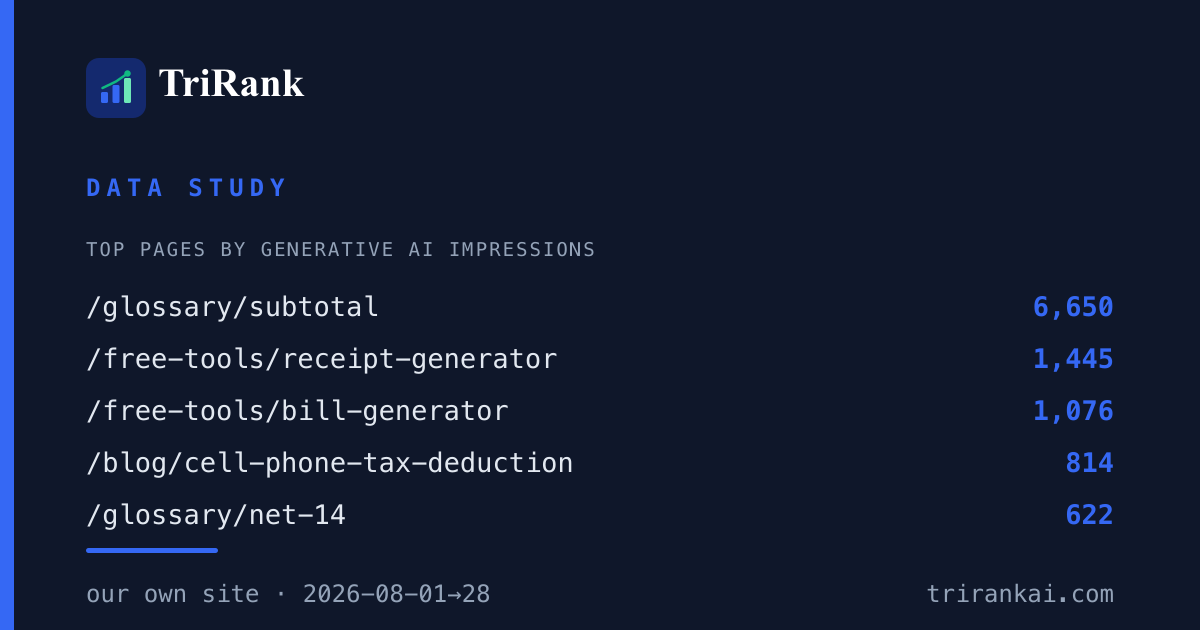
Google's Generative AI Report, Next to a Citation Sweep of the Same Site
Google now reports which pages it showed inside generative AI features. We put that export beside our own multi-engine citation sweep of the same site over the same 28 days — and the first thing worth saying is that the two denominators are nothing alike.
邮件列表
加入我们的社区
订阅邮件列表,及时获取最新消息和更新