Generative Engine Optimization (GEO): 2026 Guide
GEO is how you get cited in AI answers. Learn what GEO is, how it differs from SEO, and an 8-step playbook to earn citations and convert.
Generative Engine Optimization (GEO): The 2026 Guide
Generative Engine Optimization (GEO) is the practice of making your content the source that AI engines like ChatGPT, Google AI Mode, Perplexity, and Gemini cite when they answer a question. Where classic SEO competes for a ranked link, GEO competes to be quoted inside the generated answer itself — and the gap between the two disciplines is now wide enough to matter for almost every brand.
The urgency is no longer speculative. As of May 2026, 90% of brands had zero mentions across the AI engines tested in a 177-brand study (SEJ, May 2026). At the same time, LLM referral traffic grew 527% year over year (Search Engine Land), the GEO software market is projected to expand from $848M in 2025 to $33.7B by 2034 at a 50.5% CAGR (Dimension Market Research), and 31.3% of the US population is expected to use generative AI search in 2026 (EMARKETER). Marketers have noticed: 56% of organizations reported high GEO investment in 2025, and 94% say they are increasing it in 2026 (Conductor).
This guide defines GEO precisely, separates it from SEO and AEO, explains how AI engines actually choose their sources, and gives you an eight-step playbook you can run starting today. It closes with the honest version of the most common objection — that "being cited isn't the same as getting clicks" — and what the conversion data really says.
What is Generative Engine Optimization (GEO)?
GEO is the discipline of structuring, distributing, and proving your content so that large language models retrieve and cite it inside their generated answers. The goal is not a blue link on a results page; it is a sentence in the answer that names your brand, paraphrases your data, or links to your page as a source.
To make this concrete, imagine a buyer asks ChatGPT, "What's the best way to track brand mentions in AI search?" The engine assembles an answer from several retrieved sources. GEO is the set of practices that determine whether your page is one of those sources — whether your definition, your statistic, or your framework is the one the model paraphrases. That is a fundamentally different competition from ranking #1 on Google, and it requires its own playbook. (For the broader category, see our generative AI search glossary entry and the term explainer what does GEO stand for.)
GEO sits inside a larger shift in how discovery works. Traditional search returns a list of documents and asks the user to choose. Generative search returns a synthesized answer and chooses for the user, attributing only a handful of sources. The mechanics underneath this — a retrieval step that pulls candidate passages, followed by a generation step that composes the answer — are why GEO leans so heavily on being retrievable and quotable. If you want the technical grounding, our retrieval-augmented generation explainer covers how that retrieval-then-generate loop works.
Three properties define a GEO-ready page:
- Retrievable. The page is crawlable, well-structured, and semantically clear enough for an engine to pull the right passage, which is what semantic SEO buys you. Structured data and clean technical hygiene make this easier.
- Quotable. The page contains self-contained, factual statements — definitions, statistics, step lists — that a model can lift without distortion.
- Trusted. The page and its author carry signals (third-party validation, original data, freshness) that make the engine confident enough to cite it.
It helps to see what GEO is not. It is not keyword stuffing for robots, and it is not a trick layered on top of a thin page. Engines retrieve passages and then evaluate them for usefulness and trustworthiness; a page engineered to look quotable but lacking substance tends to be retrieved and then discarded at the generation step. GEO is therefore closer to editorial quality control than to classic technical SEO hacking. The mental shift that matters most: you are no longer writing primarily for a human scanning a list of ten links, you are writing for a model that will read your passage, judge whether it can be safely repeated, and either cite it or move on.
A second nuance is that GEO operates at two layers simultaneously — the page layer and the brand layer. At the page layer you make individual URLs retrievable and quotable. At the brand layer you make your company a recognizable entity that engines associate with specific topics, so that even unlinked mentions of your brand across the web reinforce your authority. Most teams start at the page layer because it feels familiar, but the brand layer is where the largest GEO gains live, for reasons the source-selection data makes clear later in this guide.
GEO is closely related to two adjacent disciplines, AEO and AI SEO, and the terminology is genuinely confusing. The next section clarifies it.
GEO vs SEO vs AEO: Clarifying the Terms
The short answer: SEO optimizes for ranked links, AEO optimizes for direct answers, and GEO optimizes for citations inside generated answers — and in practice the three overlap more than the labels suggest. Here is how to hold them apart without overthinking it.
| Dimension | SEO | AEO | GEO |
|---|---|---|---|
| Optimizes for | A ranked link in a list | A directly extracted answer | A citation inside a generated answer |
| Primary surface | Blue-link results | Snippets, People Also Ask, AI Overviews | ChatGPT, Perplexity, Gemini, AI Mode |
| Conversion event | The click | The answer-box win | Being named/cited in the answer |
| Success metric | Rankings and clicks | Snippet and answer wins | AI citations and brand mentions |
| Dominant levers | Relevance, authority, technical health | Question-led structure, schema | Original data, distribution, third-party validation |
SEO (Search Engine Optimization) is the original discipline: earn a high-ranking link in a list of results. The user clicks through. Relevance, authority, and technical health drive it, and it remains the foundation everything else builds on. Our AI SEO guide covers how that foundation is evolving.
AEO (Answer Engine Optimization) optimizes for direct-answer surfaces — featured snippets, People Also Ask, voice answers, and AI Overviews — where the engine extracts a concise answer, often without a click. AEO is question-led and format-led: you structure content so the right answer is easy to lift. The category is exploding; AEO-related tooling grew over 2000% year over year (G2). Read more in Answer Engine Optimization and the answer engine optimization glossary entry, or compare directly in AEO vs SEO.
GEO (Generative Engine Optimization) is the broadest of the three when it comes to AI answer engines. It targets citation and brand inclusion across generative systems — ChatGPT, Perplexity, Gemini, Google AI Mode — not just a single answer box. GEO cares about whether your brand and data show up in synthesized, multi-source answers, which means distribution and third-party validation matter as much as on-page work. For a head-to-head, see GEO vs SEO and the glossary entries GEO vs SEO and SEO vs GEO.
A useful mental model: AEO is a subset of the answer layer, and GEO is the answer layer applied specifically to generative engines. They share machinery — clean structure, strong E-E-A-T, question-led content — but their success metrics differ. SEO counts rankings and clicks; AEO counts snippet and answer-box wins; GEO counts AI citations and brand mentions in AI. TriRank's three-engine model — Google SEO + AEO + GEO — exists precisely because you cannot win one of these by ignoring the other two; they reinforce each other.
Where do the boundaries blur in practice? Consider Google AI Overviews, which sit awkwardly across all three labels: they appear on a traditional results page (SEO territory), they extract a direct answer (AEO territory), and they generate synthesized text with citations (GEO territory). The honest answer is that the labels describe emphases, not walls. A page that ranks well, answers cleanly, and carries quotable original data tends to win on all three surfaces at once, which is why arguing about taxonomy is less productive than building content that satisfies every layer. The volatility data underscores this: there is only 13.7% URL overlap between AI Mode and AI Overviews (Ahrefs, 540k pairs), meaning even two Google-owned generative surfaces draw from largely different sources. If you optimize for one and ignore the others, you leave most of the answer real estate uncontested.
One more distinction worth retiring: the idea that GEO is "just SEO with a new name." It shares roots, but the optimization target genuinely differs. In SEO you compete against the other nine results on a page and a click is the conversion event. In GEO you compete to be one of a handful of cited sources and the conversion event is being named in the answer — which may never produce a click at all. That difference cascades into how you measure success, which is why the metrics section treats GEO as its own scoreboard rather than a footnote to SEO reporting.
Why GEO Matters: The Data
GEO matters because AI search has already become a primary discovery channel while almost no one is optimized for it — a rare combination of large demand and thin competition. The headline numbers make the case on their own.
Adoption first. ChatGPT grew from 400M weekly users in early 2025 to 1B monthly users by early 2026, and Google AI Mode passed 1B monthly users by May 2026 (Google I/O 2026). On the buyer side, 51% of B2B buyers now start their research in an AI chatbot, and 71% use AI somewhere in the journey (G2 Answer Economy, 1,076 buyers, Apr 2026). 88% of organizations say ChatGPT and Perplexity are now a primary discovery channel (AirOps, 2026).
Now the competitive gap. Despite that demand, 90% of brands had zero AI mentions in the SEJ 177-brand study (SEJ, May 2026), and tracking lags badly: only 14% of organizations track AI citations (Goodfirms, 2026) and just 16% of the Fortune 500 track AI search at all (AirOps, 2026). When the channel is this large and visibility is this concentrated, early, deliberate GEO is unusually high-leverage. For the full data set, see our AI SEO statistics roundup.
This is also a defensive imperative, not just an offensive one. Classic search is leaking clicks: zero-click searches sit at 58.5% (SuperPrompt) and 93% of AI sessions end without a click (Semrush, Sep 2025). If the answer is generated and your brand isn't in it, you are invisible at the exact moment the buyer is forming an opinion. GEO is how you stay present in that moment. Our AI search engine optimization primer goes deeper on the strategic stakes.
The pressure is compounding on the supply side too. AI Overviews already cover 25.11% of queries on average (peaking at 47% in January 2026) (Conductor), and they appear on the majority of informational searches — 60% of question queries trigger an AI Overview, rising to 53% for queries of ten or more words (Pew). Forward-looking analysts expect the trend to accelerate; Gartner projects a 25% decline in traditional search volume by 2026 as users shift to AI assistants. Read together, these numbers describe a discovery surface that is expanding into exactly the high-intent, longer-tail questions where buyers make decisions — the questions where being the cited source is worth the most.
There is also a maturity signal worth weighing. The same Conductor research that found 56% high GEO investment in 2025 reported that 97% of organizations described their AEO efforts as positive in 2025 (Conductor). When nearly everyone who tries the adjacent answer-engine work reports it pays off, and 94% plan to increase GEO spend in 2026, the rational reading is not "wait and see" but "the experiment has already returned results for early movers." The brands hesitating are not avoiding risk; they are conceding ground in a channel their competitors are actively claiming. Our AI search engine optimization primer and the broader AI SEO statistics page lay out the full adoption picture.
How AI Engines Choose Their Sources
AI engines favor sources that are independently validated, contain original data, and are fresh — three signals that, fortunately, you can influence directly. Understanding the selection logic is the difference between guessing and engineering.
Third-party pages dominate. The single most counterintuitive finding for SEO veterans: 85% of AI brand mentions come from third-party pages, not the brand's own site (eMarketer, Jan 2026). Engines treat independent coverage — reviews, roundups, news, forums, comparison sites — as more credible than self-published claims. This reframes GEO as a distribution and reputation problem, not only an on-site one. Distribution compounds, too: appearing across multiple publications can lift citations by up to 325% (Stacker, Dec 2025).
Original data wins citations. 52.2% of cited passages contain original data (Search Engine Land), and adding statistics, quotes, and structured data can raise AI visibility by up to 40% (Princeton + Georgia Tech). Engines are drawn to specific, attributable facts because they reduce hallucination risk. A page that says "conversion improved" loses to a page that says "conversion improved from 5.3% to 11.4%."
Brand mentions beat backlinks. In AI-citation modeling, brand mentions correlated with citations roughly 3× more strongly than backlinks (0.664 vs 0.218) (Ahrefs, Louise Linehan, 2025). The link economy is being partly replaced by a mention economy. Read that as a reordering rather than a replacement: the study sampled only domains above DR 40, so 0.218 is what backlinks are worth inside a pool a site has already qualified to enter. Links are the threshold; mentions are what moves you once you are past it. This is why monitoring unlinked brand mentions matters; see how to track brand mentions in AI search and the LLM visibility glossary entry.
Freshness and authorship are tiebreakers. Pages updated within the last 60 days earn 28% more citations, and pages with author schema are cited about 3× more often (BrightEdge). Position on the page matters as well: 44.2% of LLM citations come from the first 30% of a page's content (Growth Memo, Feb 2026) — which is why this very article front-loads its strongest data.
To translate these signals into a working hierarchy: third-party validation and original data are the heavyweight factors, brand mention strength is the multiplier, and freshness plus authorship are the tiebreakers that decide close calls. A page can be perfectly structured and still lose to a less-polished competitor that happens to be referenced across more independent publications and carries a more specific, attributable statistic. This is the part of GEO that trips up teams arriving from a pure on-page SEO background — they over-invest in markup and under-invest in earned coverage. The data says the leverage runs the other way.
It also reframes what "good content" means for GEO. A 2,000-word explainer that paraphrases what everyone else already says is nearly invisible to an engine, because it offers nothing safer to cite than the alternatives. A 600-word page built around one original benchmark nobody else has published is far more citable. Specificity, not length, is the currency. This is why the playbook below leads with original data rather than with volume.
There is a catch that shapes everything downstream: AI citations are unstable. 45.5% of citations are replaced when an answer is regenerated (Ahrefs, Nov 2025), 40–60% of sources change month to month, and 91% of citations appear in only a single engine (Growth Memo, May 2026). Even running the identical query repeatedly produces inconsistent source sets — asking the same question 100 times surfaces the same brands less than once per hundred runs (SparkToro, Jan 2026). Being cited once is not a durable win. That volatility is the core reason GEO requires continuous monitoring rather than a one-time audit — a theme the playbook returns to.
How to Do GEO: An 8-Step Playbook
The fastest path to citations is to combine quotable on-page content with third-party distribution and continuous measurement — in that order of leverage. Here is a practical sequence you can run.
Step 1 — Fix the technical foundation. Engines cannot cite what they cannot retrieve. Confirm clean crawlability, a valid sitemap.xml, sensible robots.txt, and structured data on key pages. Consider an llms.txt file to signal which content you want surfaced. A free llms.txt generator drafts one from your key pages. Good old SEO hygiene is the price of entry for GEO.
Step 2 — Front-load quotable, self-contained answers. Put the direct answer in the first sentence of the page and each section, since 44.2% of citations come from the first 30% of content (Growth Memo, Feb 2026). Write statements that stand alone without surrounding context, so a model can lift them cleanly.
Step 3 — Publish original data. Run a survey, analyze your own product data, or compile a benchmark — because 52.2% of cited passages contain original data (Search Engine Land) and original stats lift visibility up to 40% (Princeton + Georgia Tech). Original data is the most defensible GEO asset you can own because competitors cannot copy a number you generated.
Step 4 — Earn third-party coverage. Since 85% of AI brand mentions come from third-party pages (eMarketer, Jan 2026), invest in PR, expert roundups, review sites, and guest data placements. Multi-publication distribution can raise citations up to 325% (Stacker, Dec 2025). Treat earned mentions as a primary GEO channel, not an afterthought.
Step 5 — Strengthen entity and topical signals. Build topical authority and clear entity SEO so engines understand who you are and what you are an authority on. Consistent entity signals across the web make your brand easier to retrieve and attribute.
Step 6 — Add author and freshness signals. Apply author schema markup, display credentials, and keep cornerstone pages updated, since fresh pages earn 28% more citations and author schema triples citation likelihood (BrightEdge). Build a refresh cadence into your editorial calendar.
Step 7 — Optimize for specific generative engines. Because 91% of citations appear in a single engine (Growth Memo, May 2026), you must target each engine, not assume one win travels. Start with the get-cited-by-ChatGPT playbook for the largest surface, then extend to Perplexity and Google AI Mode.
Step 8 — Monitor citations continuously and act on the data. Given that 45.5% of citations are replaced on regeneration (Ahrefs, Nov 2025), GEO is a maintenance discipline, not a launch. This is where a watchlist of tracked queries — and automated execution against what it surfaces — pays off. TriRank's watchlist monitors AI citations across engines, its reports run on your real Google Search Console data with a monthly archive and exportable, white-label output, and its autopilot can automate the repetitive execution steps so the loop actually closes. See AI citation tracking guide for the discipline behind step 8.
Run these in order and the early steps compound into the later ones: a technically clean, data-rich page is easier to distribute, and distribution feeds the citations your monitoring will track.
A note on sequencing and patience. GEO is not a campaign with a launch date; it is a flywheel. The first turns feel slow because engines update their retrieval corpora on their own cadence and because, as the volatility data shows, early citations are easily displaced. Teams that quit after a month of flat results usually quit just before the compounding begins — original data gets referenced by a third party, that reference gets indexed, the engine starts associating your brand with the topic, and citations begin to appear and persist. The honest expectation to set internally is a multi-month horizon with measurable leading indicators (mentions, source coverage) well before the lagging indicator (durable citations) stabilizes. This is exactly why step 8 is non-negotiable: without continuous measurement you cannot tell the difference between "GEO isn't working" and "GEO is working but hasn't surfaced yet."
To make the playbook tangible, walk through a single page. Suppose you run a B2B analytics company and want to own the question, "how do I measure AI search visibility?" Step 1: confirm the page is crawlable and carries article and author schema. Step 2: open with a one-sentence direct answer and put your strongest number in the first paragraph. Step 3: publish a small original benchmark — say, citation-replacement rates you measured across your own tracked queries — so the page contains a statistic no competitor can copy. Step 4: pitch that benchmark to two industry newsletters and a roundup, earning third-party references. Step 5: interlink it with your other measurement content to build topical authority. Step 6: stamp it with a credentialed author and a visible "last updated" date, refreshing the benchmark quarterly. Step 7: check whether ChatGPT, Perplexity, and Google AI Mode each cite it, and tune per engine. Step 8: add the page's target queries to a watchlist and watch citation share over eight weeks, not eight days. That is GEO end to end on one URL — and it scales by repetition, not by reinvention.
Measuring GEO: The Metrics That Matter
You measure GEO by tracking citations, brand mentions, and the quality of the traffic those citations produce — not by the vanity metrics borrowed from classic SEO. Because the channel is new, picking the right scoreboard is half the battle.
Start with citation share: across a defined set of tracked queries, how often is your brand cited versus competitors? Because citations are volatile — 45.5% replaced on regeneration (Ahrefs, Nov 2025) and 40–60% of sources changing monthly — a single snapshot is misleading. You need a trend line over weeks, which is exactly why monitoring is non-negotiable. Pair it with brand-mention frequency (linked and unlinked), since mentions correlate with citations roughly 3× more strongly than backlinks (Ahrefs, Linehan, 2025).
Two engine-specific realities shape measurement. First, 91% of citations live in a single engine (Growth Memo, May 2026) and there is only 13.7% URL overlap between AI Mode and AI Overviews (Ahrefs, 540k pairs) — so measure per engine, never in aggregate only. Second, results are noisier than they look: asking the same question 100 times surfaces the same brands less than once in 100 runs (SparkToro, Jan 2026), which means you should sample repeatedly and report distributions, not single pulls.
Beyond citation share and mention frequency, two outcome-side metrics close the loop. The first is share of voice within the answer — not merely whether you appear, but whether you appear prominently versus being buried among competitors. Because 44.2% of citations come from the first 30% of a page's content (Growth Memo, Feb 2026), the same prominence logic applies to where your brand lands inside the generated answer. The second is conversion quality of AI-referred traffic, which is where GEO's value actually banks: AI visitors convert at 11.4% versus 5.3% for organic (Similarweb, 2026) and over-index on signups roughly 23× (Ahrefs, 2025). A mature GEO dashboard reports both the visibility metrics (citations, mentions, prominence) and the outcome metrics (conversion rate, signup contribution) so leadership can see that low-volume traffic is doing high-value work.
A word on instrumentation. Connecting AI citations to real outcomes requires grounding your reporting in actual data rather than estimates. TriRank's reports run on your real Google Search Console data with a monthly archive, so the trend line you act on reflects measured demand rather than a third-party model's guess — and the output is exportable and white-labelable, which matters for agencies reporting to clients. The why use AI search monitoring tools article makes the case for grounded measurement in more depth.
For the full metric framework — including how to connect citations to downstream outcomes — see AI search visibility metrics and KPIs. The practical point is that GEO measurement is a monitoring problem: you are tracking a moving target across multiple engines, and manual spot-checks cannot keep up. With only 14% of organizations tracking AI citations (Goodfirms, 2026), the teams that instrument this well gain not just visibility but a genuine information advantage over competitors who are flying blind.
GEO Tools: What to Look For
The right GEO tool tracks citations across multiple engines, separates linked from unlinked mentions, and analyzes which sources are feeding the engines so you can act — capabilities that go well beyond a rank tracker. The market is young, so evaluate on substance rather than branding.
Prioritize five capabilities:
- Multi-engine citation monitoring. A watchlist that tracks named queries across ChatGPT, Perplexity, Gemini, and Google AI Mode, given that 91% of citations are single-engine (Growth Memo, May 2026). One engine's blind spot is another's opportunity.
- Brand-mention tracking, linked and unlinked. Because mentions outweigh backlinks ~3× for citations (Ahrefs, Linehan, 2025), tools must catch unlinked mentions, not just hyperlinks. See brand mentions in AI.
- Citation-source analysis. Knowing your brand was cited is step one; knowing which third-party pages feed the engines tells you where to invest, given that 85% of mentions come from third-party pages (eMarketer, Jan 2026).
- Reporting on real search data. Reports grounded in actual Google Search Console data — archived monthly, exportable, and white-labelable for agencies — beat estimated metrics.
- Automated execution. Monitoring without action is a dashboard; the value is in closing the loop.
This is where TriRank's design maps cleanly onto the discipline. Its watchlist handles multi-engine AI-citation monitoring; its reports run on real GSC data with a monthly archive and exportable, white-label output; its T2/T3 citation-source analysis traces which third-party sources are driving (or replacing) your citations — directly addressing the 45.5% replacement problem (Ahrefs, Nov 2025); and its autopilot automates the repetitive execution. The three-engine model ties Google SEO, AEO, and GEO into one workflow rather than three disconnected tools.
For comparisons across the category, see best LLM SEO tools and our AI citation tracking guide. The honest framing: no tool earns citations for you — tools tell you where you stand and what changed, so your content and distribution work can be targeted instead of blind.
GEO Engine by Engine: ChatGPT, Perplexity, and Google AI Mode
Because 91% of citations appear in only a single engine (Growth Memo, May 2026), GEO is not one game but several played in parallel — and the engines reward different things. Treating them as interchangeable is the most common reason a brand wins citations in one place and stays invisible everywhere else.
ChatGPT is the largest surface, having grown from 400M weekly users in early 2025 to 1B monthly users by early 2026. Its search behavior leans heavily on retrieved web sources and on well-structured, authoritative pages. Because it now sits inside the daily workflow of so many buyers — recall that 51% of B2B buyers start research in an AI chatbot (G2, Apr 2026) — it is usually the first engine worth optimizing for. The get-cited-by-ChatGPT playbook covers its specifics, but the short version is the same fundamentals weighted toward clear, quotable, recently updated pages.
Perplexity is the most citation-transparent of the major engines, surfacing its sources prominently and favoring pages dense with verifiable, attributable facts. It rewards the original-data discipline especially well, since its answers lean on referenced statistics. If your GEO assets are statistic-rich, Perplexity often picks them up first. For a feature-level contrast between the two, see the Perplexity vs ChatGPT glossary entry.
Google AI Mode and AI Overviews blend generative answers with Google's existing ranking signals, which means strong classic SEO carries more weight here than on the pure-LLM engines. With Google AI Mode past 1B monthly users by May 2026 (Google I/O 2026) and AI Overviews covering up to 47% of queries at peak (Conductor), this surface is too large to skip — but remember the 13.7% URL overlap between AI Mode and AI Overviews (Ahrefs, 540k pairs) means even these two Google surfaces must be checked separately. The conversational search and google-ai-mode entries go deeper.
The practical implication is a per-engine workflow: produce one strong, data-rich asset, then verify and tune its citation status in each engine independently rather than assuming a single win generalizes. A watchlist that tracks the same queries across all engines turns this from guesswork into a checklist — which is precisely the gap GEO monitoring tools exist to close.
Common Misconceptions About GEO
The most damaging GEO myths are that it replaces SEO, that one citation is permanent, and that citations don't matter because they don't drive clicks — and all three fall apart under the data. Let's take them honestly.
Myth 1 — "GEO replaces SEO." It does not. GEO is built on SEO's foundation: crawlability, structure, E-E-A-T, and topical authority all feed retrieval. The three-engine model exists because SEO, AEO, and GEO reinforce each other. Abandoning SEO to chase GEO removes the substrate the engines retrieve from.
Myth 2 — "Get cited once and you're done." Citations are unstable: 45.5% are replaced on regeneration (Ahrefs, Nov 2025), 40–60% of sources change monthly, and 91% are single-engine (Growth Memo, May 2026). GEO is maintenance, not a milestone — which is the whole argument for continuous monitoring.
Myth 3 — "AI citations don't matter because they don't bring clicks." This is the serious objection, and it deserves a serious answer rather than a dismissal. The skeptic is partly right: with 93% of AI sessions ending without a click (Semrush, Sep 2025) and zero-click at 58.5% (SuperPrompt), GEO will not deliver the raw traffic volume that classic SEO once did. If you judge GEO by sessions alone, it looks weak.
But raw volume is the wrong yardstick, because the traffic that does arrive is exceptionally qualified. AI visitors made up 12.1% of signups while being only 0.5% of traffic — roughly a 23× over-index on conversion (Ahrefs, 2025). Independently, AI-referred visitors converted at 11.4% versus 5.3% for organic (Similarweb, 2026). The reason is intuitive: a user arriving from a generative answer has already had their question framed and your brand pre-vetted by the engine. They show up further down the funnel.
So the accurate statement is this: GEO produces low volume but high-quality outcomes. A citation is not a click — it is a recommendation delivered at the moment of decision, and recommendations convert. Judging GEO by sessions misses where the value lands. (For the data behind the funnel argument, see AI SEO statistics.)
Myth 4 — "Tools earn citations for you." They don't. Tools like TriRank tell you where you stand, which sources drive your citations, and what changed — but the content quality, original data, and third-party distribution are still the work. Honest GEO software shortens the feedback loop; it doesn't replace the strategy.
Putting GEO Into Practice
GEO is winnable right now precisely because the channel is large and the field is mostly empty — 90% of brands have zero AI mentions (SEJ, May 2026) while adoption races toward a third of the US population (EMARKETER). The brands that build quotable, data-rich, well-distributed content and monitor their citations continuously will define the answers their categories are built on.
The work is concrete: fix the technical foundation, front-load original data, earn third-party coverage, target each engine separately, and measure citations as a moving target rather than a one-time score. None of it is exotic; most of it is disciplined execution of things you already half-know how to do. The differentiator is consistency — and the willingness to treat citation volatility (45.5% replaced on regeneration, Ahrefs, Nov 2025) as a monitoring problem instead of ignoring it.
If you want a clear starting point, run a free audit to see where your brand currently stands across the AI engines, then close the gaps the data reveals. Start with a free audit to baseline your AI visibility, and review pricing when you're ready to put the watchlist, citation-source analysis, and autopilot to work across all three engines.
Frequently Asked Questions
What is GEO? Generative Engine Optimization (GEO) is the practice of structuring, distributing, and validating your content so AI engines — ChatGPT, Perplexity, Gemini, Google AI Mode — cite it inside their generated answers. The target is a citation or brand mention within the answer, not a ranked link. With 90% of brands holding zero AI mentions (SEJ, May 2026) and LLM referral traffic up 527% YoY (Search Engine Land), GEO is an emerging, high-leverage discipline. See generative AI search for the broader concept.
GEO vs SEO — what's the difference? SEO optimizes for ranked links you click through to; GEO optimizes for citations inside AI-generated answers. SEO counts rankings and clicks; GEO counts citations and brand mentions. They share foundations — clean structure, authority, E-E-A-T — but use different scoreboards, and GEO leans more on third-party validation, since 85% of AI brand mentions come from third-party pages (eMarketer, Jan 2026). Full comparison in GEO vs SEO.
How do I optimize for ChatGPT? Front-load self-contained answers (44.2% of citations come from the first 30% of content, Growth Memo, Feb 2026), publish original data (52.2% of cited passages contain it, Search Engine Land), earn third-party coverage, and add author and freshness signals (fresh pages earn 28% more citations, BrightEdge). Then monitor, because 91% of citations are single-engine (Growth Memo, May 2026). The step-by-step is in the get-cited-by-ChatGPT playbook.
Does GEO actually bring traffic? Honestly, GEO brings mostly citations, not high-volume clicks — 93% of AI sessions end without a click (Semrush, Sep 2025). But the traffic that arrives converts exceptionally well: AI visitors were 12.1% of signups while only 0.5% of traffic (~23×) (Ahrefs, 2025) and converted at 11.4% versus 5.3% for organic (Similarweb, 2026). GEO trades volume for quality: low clicks, high-intent buyers pre-vetted by the engine.
Author

Categories
Free tools for this
More Posts
AI SEO: The Complete 2026 Guide
AI SEO is optimizing to be found and cited across Google, answer engines, and AI chatbots. A data-driven 2026 guide to strategy, tools, and KPIs.
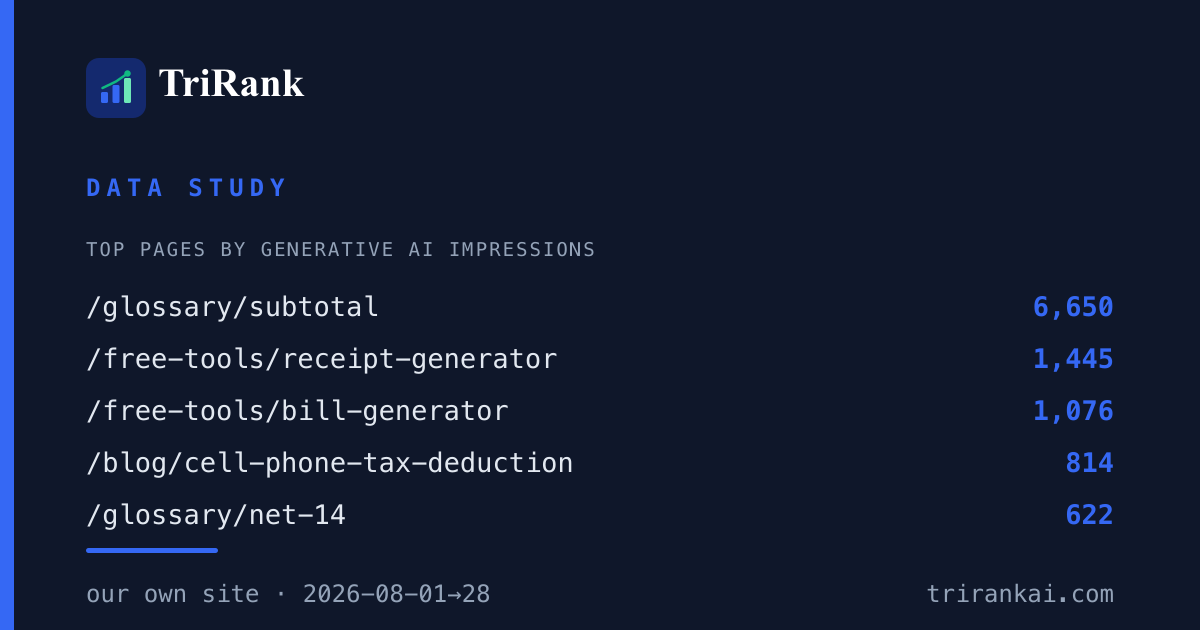
Google's Generative AI Report, Next to a Citation Sweep of the Same Site
Google now reports which pages it showed inside generative AI features. We put that export beside our own multi-engine citation sweep of the same site over the same 28 days — and the first thing worth saying is that the two denominators are nothing alike.
Self-Hosting Your SEO Stack: What It Actually Costs
Open-source SEO tools are having a moment, and self-hosting one is a real option. Here is the honest arithmetic: metered data fees, maintenance, a history that starts at zero, and one upstream you do not control.
Newsletter
Join the community
Subscribe to our newsletter for the latest news and updates