Why Use AI Search Monitoring Tools
Most brands have zero AI mentions and never know it. Here is why AI search monitoring tools matter, what they detect, and how to track visibility.
You should use AI search monitoring tools because roughly 90% of brands have zero presence in AI-generated answers, and without monitoring you have no way of knowing whether you are one of them. That figure comes from a Search Engine Journal study of 177 brands published in May 2026, and it reframes the whole question. The risk is not that your visibility is slipping by a few points; it is that for a fast-growing share of buyer questions, your brand may not exist in the answer at all. Monitoring is how you find out, and it is the first step toward doing anything about it.
The discomfort with that statistic is that you cannot feel it. A page that loses Google rankings shows up in your analytics as a traffic decline you can investigate. A brand that is absent from a ChatGPT or Perplexity answer produces no signal whatsoever, because the buyer who asked never visited your site to begin with. Monitoring tools exist to make that silence visible, turning an invisible absence into a measurable gap you can act on. The discipline of AI search monitoring is, at root, about restoring a feedback loop that AI answers have quietly removed. This guide explains why that matters now, what these tools actually detect, and how a watchlist approach keeps you current as answers shift.
Why monitor AI search at all
Monitor AI search because a meaningful share of buyer research now happens inside answer engines you cannot see into without a tool. The behavioral shift is no longer hypothetical: 88% of brands now cite ChatGPT and Perplexity as a primary discovery channel, according to AirOps (2026), and EMARKETER projects that 31.3% of US consumers will use generative AI for search in 2026. When a third of your potential audience may meet your category inside a synthesized answer, the contents of that answer become a competitive surface in their own right.
The problem is that this surface is opaque by default. Traditional analytics report on visits that happen; AI answers shape decisions that never produce a visit. A buyer can read a paragraph that names three competitors and omits you, form an impression, and move on, all without a single line appearing in your logs. The only way to know what those answers say about you is to run the questions yourself, repeatedly and systematically, which is precisely what a monitoring tool automates. It is the difference between assuming you are present and confirming it.
There is also a strategic reason to start now rather than later. The monitoring gap is wide: only 14% of brands currently track AI citations, per Goodfirms (2026), and just 16% of Fortune 500 companies appear in AI answers, according to AirOps. That gap is an opportunity. Brands that measure their AI visibility early can identify and close the questions where they are missing while most competitors are still flying blind. For a fuller picture of the metrics worth watching, our guide to AI search visibility metrics and KPIs breaks down what to track and why.
What AI search monitoring detects
AI search monitoring detects three things a rank tracker cannot: whether your brand is named in an answer, how it is described, and whether your own pages are cited as the source. Each of these is a distinct layer of visibility, and a serious tool reports on all three rather than collapsing them into a single number.
| Layer | What it answers | What it catches | Traditional SEO analogue |
|---|---|---|---|
| Presence | Are we named in the answer at all? | Total absence (the 90% at zero) | Roughly: ranking |
| Framing | How are we described? | Outdated or inaccurate claims about you | None |
| Citation | Which URL is credited as the source? | A rival or review site cited in your place | None |
The first layer is presence. For any given question, does the synthesized answer mention your brand at all? This is the most basic check, and for the 90% of brands sitting at zero it is also the most sobering. Presence monitoring runs a defined set of questions across engines and records, answer by answer, whether you appear among the named options. Without it, "are we showing up?" is a guess.
The second layer is framing. Being named is not the same as being named well. An answer might describe you accurately, or it might attach an outdated claim, a misremembered feature, or a comparison that flatters a rival. Monitoring captures the language the engine uses about you, which is the only way to catch a description that is technically a mention but practically a liability. This is closer to brand reputation tracking than to ranking, and it has no analogue in traditional SEO.
The third layer is citation. When an engine makes a claim about your category, which URL does it credit as the source? This is where monitoring earns its keep, because it routinely reveals that a review site, a competitor's comparison page, or a third-party listicle is cited as the authority on your own product. Understanding AI citations at the source level tells you not just that you are missing, but who is being credited in your place, and therefore which page you need to study and outdo. Our AI citation tracking guide goes deeper on how to read and act on that source-level data.
Taken together, these three layers are what LLM visibility actually measures, and they explain why a rank tracker cannot stand in for a monitoring tool. A rank tracker reports a position on a page; presence, framing, and citation describe whether you exist inside an answer, how you are characterized, and who gets the credit. None of those map onto a number between one and one hundred, which is why the AI era needs its own instruments rather than a relabeled version of the old ones.
The cost of not monitoring: invisible loss
The real cost of not monitoring is invisible loss: demand that moves to competitors named in answers you never saw, leaving no trace in your analytics. This is the most important reason to use a monitoring tool, and the hardest one to feel without it.
Consider how this plays out. A buyer in your category asks an answer engine for the best options. The engine names three vendors and cites two comparison pages. Your brand is absent. The buyer shortlists those three, evaluates them, and chooses one. At no point in this sequence did your site receive a visit, an impression in your dashboard, or any signal you could investigate. You simply lost a prospect to a sentence you cannot see. Multiply that across the rising volume of AI-mediated research and the loss is structural, not occasional.
This is what separates AI invisibility from a ranking decline. When you fall from position one in Google, you can read the impact in your click-through data, because zero-click search and CTR shifts still register as changes in your existing reports. When you are absent from an AI answer, there is no before-and-after to compare, because you were never in the data to begin with. The loss is real but unrecorded, which is exactly why it persists: you cannot fix a problem your instruments do not show you. A monitoring tool is the instrument. It converts an absence that produces no signal into a list of specific questions where you are missing, which is the only form of the problem you can actually work on.
The volatility problem: why one check is not enough
You cannot rely on a single check because AI citations are volatile: a large share of the sources behind any answer change from month to month, so a snapshot goes stale almost immediately. Ahrefs found in November 2025 that 45.5% of citations were replaced over its measurement window, and the broader pattern is 40 to 60% of cited sources changing month to month. A position you confirmed in May can be gone in June without any change on your part.
The instability runs deeper than turnover. Ahrefs' analysis of 540,000 queries found only 13.7% overlap in the sources cited for the same question across runs, and SparkToro reported in January 2026 that asking an identical question 100 times produced a given source fewer than 1 in 100 times in many cases. Answers are non-deterministic; the same prompt returns different sources across sessions, regions, and model updates. A single check, even an accurate one, captures one draw from a distribution rather than a stable fact.
This volatility is the core argument for continuous tracking over one-off audits. The value of monitoring is not the snapshot; it is the trend line built from many snapshots run on a schedule. Only a series of measurements can distinguish a real gain from a lucky session, or a genuine decline from ordinary noise. The volatility is also why fragmentation matters: Growth Memo reported in May 2026 that 91% of sources appear in only a single engine, so a position in one assistant tells you little about the others. Tracking has to be both repeated over time and spread across engines to mean anything, which is more than any manual process can sustain.
Features a monitoring tool should have
The features that matter most are continuous tracking, multi-engine coverage, citation-source analysis, and reporting you can act on. Given the volatility above, anything less produces a number you cannot trust. Our roundup of the best AI search monitoring tools walks through how to judge each of these criteria in practice.
Continuous, scheduled tracking comes first. Because the same question yields different sources across runs, a credible tool runs your question set repeatedly and stores history, so you read a pattern rather than a single noisy result. A tool that presents a one-off result as a stable fact is misleading by design.
Multi-engine coverage comes second. With 91% of sources appearing in only one engine, a tool that watches a single assistant gives you a partial and potentially misleading view. Look for coverage of the major answer engines your audience actually uses, with each treated as its own scoreboard rather than blended into an average that hides the real gaps.
Citation-source analysis comes third. Presence alone tells you that you are missing; source-level data tells you who is cited instead and which page you need to answer better. This is the layer that connects a visibility gap to a concrete next action, and it is the difference between a dashboard that reports a problem and one that points at a fix. For the mechanics of doing this manually, see how to track brand mentions in AI search.
Finally, reporting that you can share and act on. Raw data is a starting point, not an answer. The better tools translate findings into the questions you are losing, the competitors cited in your place, and the changes most likely to move the result, in a form you can hand to stakeholders who do not live in the dashboard.
How TriRank's watchlist does this
TriRank approaches monitoring through a watchlist built on AI-citation tracking across the three-engine model: traditional SEO, AEO, and GEO treated as one connected system rather than separate tools. The watchlist runs your defined question set across the major answer engines on a schedule, recording presence, framing, and citation source rather than ranking position alone, and storing history so you watch the trend instead of a single draw. That directly addresses the volatility problem above: a series of scheduled runs is the only honest way to read a surface where 40 to 60% of sources change monthly.
On the source side, the watchlist's citation analysis surfaces which URLs the engines credit when they answer questions in your category, including the uncomfortable common case where a third-party page is cited as the authority on your own product. Because TriRank treats the three engines as one system, a gap the watchlist finds in AI answers is tied back to the content, structured data, or authority change most likely to make you the cited source next time, rather than left as a standalone alarm. For a wider comparison of what is available in this category, our roundup of the best AI search visibility tools for 2026 places the watchlist approach alongside other options.
The honest framing is that monitoring is necessary but not sufficient. Seeing that you are absent from 90% of answers is the prompt to act, not the act itself; the work of becoming the cited answer is what follows. What a watchlist provides is the reliable, repeated visibility that makes that work targeted rather than guessed. If you have never seen what AI engines actually say about your brand, a free audit runs a representative question set across the major engines and shows where you are named, where you are missing, and which pages are cited in your place.
FAQ
Why should I monitor AI search?
Monitor AI search because roughly 90% of brands have zero presence in AI answers (Search Engine Journal, May 2026) and there is no way to know whether you are one of them without checking. Unlike a ranking decline, AI absence produces no signal in your analytics, so the loss is invisible until you measure it directly. With 88% of brands citing ChatGPT and Perplexity as a primary discovery channel (AirOps, 2026), the contents of those answers have become a competitive surface worth watching.
What can AI search monitoring tools detect?
AI search monitoring tools detect three layers: whether your brand is named in an answer, how it is described, and whether your own pages are cited as the source. Presence tells you if you appear at all; framing captures the language the engine uses about you, including outdated or unflattering claims; and citation analysis reveals which URLs are credited, often surfacing that a competitor or review site is cited as the authority on your own product.
How often should I check my AI visibility?
Check continuously rather than once, because AI answers are volatile: 40 to 60% of cited sources change month to month, and Ahrefs found only 13.7% source overlap across 540,000 queries. A single check captures one draw from a shifting distribution, so it can show a gain that was luck or a decline that was noise. Scheduled, repeated tracking across multiple engines is the only way to read a real trend, which is why a watchlist beats a one-off audit.
Author

Categories
More Posts
AthenaHQ Alternatives in 2026 (Source-Checked Pricing)
AthenaHQ alternatives compared on what each vendor publishes on its own pages. Athena's plans read August 31, 2026 — Free, Starter $295/month, Enterprise custom — with Otterly.ai, Peec AI, Profound and TriRank beside them, every figure dated.
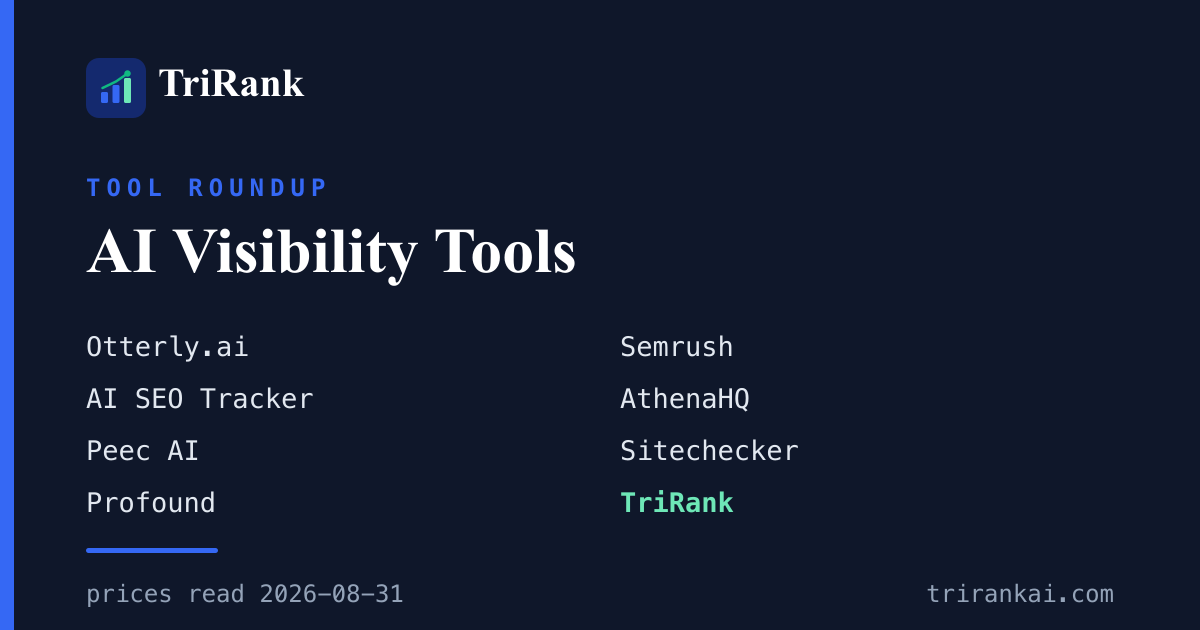
Best AI Visibility Tools (2026), With Every Price Read on One Day
Eight AI visibility tools compared only on what their own pages say, with every figure carrying the date we read it. Prices read 2026-08-31, ordered by lowest published monthly price, not ranked.
Otterly.ai Alternatives in 2026 (Source-Checked Pricing)
Otterly.ai alternatives compared on what each vendor publishes on its own pages. Otterly's plans as read on August 29, 2026 — Lite $29, Standard $189, Premium $489 — with Peec AI, AthenaHQ, Profound and TriRank beside them, every figure dated.
Newsletter
Join the community
Subscribe to our newsletter for the latest news and updates