AI SEO: The Complete 2026 Guide
AI SEO is optimizing to be found and cited across Google, answer engines, and AI chatbots. A data-driven 2026 guide to strategy, tools, and KPIs.
AI SEO is the practice of optimizing your content so it is discovered, retrieved, and cited not only by traditional search engines but by AI answer engines and generative chatbots such as Google AI Mode, ChatGPT, and Perplexity. It extends classic search engine optimization into a world where a large share of queries are resolved inside an AI-generated answer rather than on a page of blue links. The discipline matters now because the traffic is moving fast: LLM referral traffic grew 527% year over year from 2024 to 2025, according to Search Engine Land, while the generative-engine-optimization market is projected to expand from $848M in 2025 to $33.7B by 2034, a 50.5% CAGR, according to Dimension Market Research. If your brand is invisible in those answers, you are invisible to a rapidly growing portion of demand.
This guide defines AI SEO clearly, explains why it is no longer optional in 2026, compares it to traditional SEO, and then walks through the three engines that make up a complete program — Google SEO, answer engine optimization, and generative engine optimization. After that we cover end-to-end execution, measurement, tool selection, common mistakes, and the trends shaping the year ahead. Throughout, every statistic is sourced, and the strongest numbers come first so you can make decisions without reading to the bottom.
What is AI SEO?
AI SEO is the optimization of content and brand presence so that AI systems — search engines with AI Overviews, dedicated answer engines, and generative chatbots — surface and cite your material when they answer a user's question. Where traditional SEO competes for a ranked position on a results page, AI SEO competes to be the source an AI model trusts enough to quote, summarize, or recommend. The unit of success shifts from a click on a link to a citation inside a synthesized answer.
Three things make this distinct from the SEO most teams already know. First, the destination is often an answer, not a page: zero-click search now accounts for 58.5% of all Google queries, according to SuperPrompt, meaning the majority of searches are resolved without a visit to any website. Second, the retrieval mechanics differ — AI models pull from a blend of their training data, live web retrieval, and structured signals, so practices like schema markup, structured data, and clear entity definitions carry more weight. Third, the surfaces are fragmented: a brand can be cited heavily in one engine and absent from another, so a single ranking number no longer describes your visibility.
In practical terms, AI SEO blends three motions. Traditional search engine optimization keeps your pages crawlable, fast, and authoritative. Answer engine optimization structures content so it can be lifted cleanly into a direct answer. And generative AI search optimization — often called GEO — earns the trust signals and third-party mentions that large language models draw on when they generate a response. TriRank's three-engine model is built around exactly this combination, and the rest of this guide treats each motion in turn.
Why you must do AI SEO in 2026
You must do AI SEO in 2026 because user behavior, market investment, and the economics of conversion have all crossed thresholds that make AI visibility a primary growth channel rather than an experiment. The clearest signal is on the demand side: 31.3% of the US population will use generative AI search in 2026, according to EMARKETER, and Google AI Mode passed one billion monthly users in May 2026, according to Google I/O 2026. ChatGPT moved from 400M weekly active users in early 2025 to one billion monthly active users by early 2026. These are not niche audiences; they are mainstream discovery surfaces.
The economics reinforce the urgency. AI-search visitors convert dramatically better than other traffic. Ahrefs (2025) found that AI-search visitors made up just 0.5% of traffic but 12.1% of signups — roughly a 23x conversion advantage. Similarweb (2026) measured AI referral conversion at 11.4% versus 5.3% for organic, a 2.15x edge. And the G2 Answer Economy study of 1,076 buyers in April 2026 found that 51% of B2B software buyers now more often start their research in an AI chatbot, with 71% using AI somewhere in the journey. The visitors that AI search sends are fewer in raw count but far more valuable per session.
Meanwhile the traditional channel is contracting. AI Overviews already cover 25.11% of queries on average (34.5% average presence, with a January 2026 peak of 47%), according to Conductor's analysis of 21.9M queries. When an AI Overview appears, the #1 organic click-through rate drops 58%, according to Ahrefs. Semrush (September 2025) found that 93% of AI search sessions end with no click at all, and Gartner projects traditional search volume will fall 25% by 2026. The pie that classic SEO competes for is shrinking, while the AI answer surface that AI SEO addresses is expanding. The strategic conclusion is to participate in both — which is what our AI search visibility metrics and KPIs framework is designed to track.
The most striking gap, though, is competitive. Most brands have done nothing. A Search Engine Journal study of 177 brands in May 2026 found that 90% of brands have zero mentions in AI search. Only 14% of marketers track AI citations, according to Goodfirms (2026), and only 16% of Fortune 500 companies track AI search, according to AirOps. The brands that act now face an open field. You can read the full dataset in our AI SEO statistics roundup.
There is a buyer-behavior dimension that compounds the case. AI search does not just intercept informational queries; it increasingly mediates commercial research. The G2 finding that 51% of buyers more often start in an AI chatbot, paired with 88% of leaders saying ChatGPT and Perplexity are already a primary discovery channel (AirOps, 2026), means the moment a prospect forms a shortlist is now happening inside an AI answer you may not appear in. Because the same question can return a different brand list on each run — fewer than one in 100 runs produces the same list, according to SparkToro (January 2026) — being mentioned occasionally is not enough; you need consistent, well-sourced presence so the model has multiple reasons to surface you. That consistency is earned through the three-engine work described later in this guide, and it is the difference between appearing in a buyer's shortlist and being invisible at the exact moment of consideration.
AI SEO vs traditional SEO
AI SEO and traditional SEO share a foundation but diverge on what they optimize for, how success is measured, and which signals matter most. Traditional SEO optimizes a page to rank on a results page and earn a click; AI SEO optimizes content and brand presence to be retrieved and cited inside an AI-generated answer, where the click may never happen. Both rely on crawlable, authoritative, well-structured content — but AI SEO adds layers that classic SEO never needed.
The table below summarizes the core differences.
| Dimension | Traditional SEO | AI SEO |
|---|---|---|
| Primary goal | Rank position and clicks | Citation and brand mention in answers |
| Success metric | Rankings, organic traffic, CTR | Citation share, mention frequency, AI referral conversion |
| Key surface | Google SERP | AI Overviews, ChatGPT, Perplexity, Gemini, AI Mode |
| Strongest signal | Backlinks and on-page relevance | Brand web mentions, original data, structured content |
| Result stability | Relatively stable rankings | Volatile; sources change frequently |
The signal weighting is the deepest change. Ahrefs, Louise Linehan, 2025 found that brand web mentions correlate with AI Overview visibility three times more strongly than backlinks do — a correlation of 0.664 versus 0.218. In other words, what people say about you across the web now outpredicts your link profile for AI visibility. One caveat travels with that number, and it matters most if your domain is young: the study sampled only domains above DR 40, so the comparison describes sites already inside the retrieval pool, not sites still trying to get into it. Content substance matters too: stats, expert quotes, and structured data can boost AI visibility by up to 40%, according to a Princeton and Georgia Tech GEO study, and 52.2% of cited passages contain original or proprietary data, according to Search Engine Land.
Volatility is the other big departure. Where a strong traditional ranking can hold for months, AI citations churn constantly. Ahrefs (November 2025) found that 45.5% of citations are replaced on regeneration, and 40–60% of cited sources change monthly. Ask the same question 100 times and the same brand appears on the list fewer than once in 100 runs, according to SparkToro (January 2026). This is why AI SEO requires continuous monitoring rather than a one-time audit — a point we develop in GEO vs SEO and AEO vs SEO.
It is important to be clear about what does not change. AI SEO is additive, not a replacement. The technical fundamentals of traditional SEO — crawlability, index coverage, a clean robots.txt, a complete sitemap, fast core web vitals, and durable topical authority — remain the prerequisite for everything that follows. AI Overviews are assembled from Google's existing index, so a page that cannot be crawled or ranked conventionally has almost no path into an AI answer. Verifying that indexation is where teams stumble first, because the report they learned to check has since been renamed and reshaped; our guide to alternatives to the Index Coverage report covers where those answers live now. The mistake is to imagine the two are in tension. In practice, the strongest AI SEO programs are built on a healthy traditional SEO base and then layered with answer-first structure and earned brand presence. Teams that abandon their fundamentals to chase AI citations tend to lose both. The right framing, which our AI search engine optimization guide develops in full, is a single program with three coordinated outputs rather than two competing initiatives.
The three engines: Google SEO, AEO, and GEO
A complete AI SEO program runs three engines in parallel — traditional Google SEO, answer engine optimization, and generative engine optimization — because each addresses a different surface where buyers now find answers. This three-engine model is the "Tri" in TriRank: no single engine covers the whole field, and brands that optimize for only one leave the majority of AI surfaces unaddressed. Engines rarely overlap. Ahrefs found, across 540,000 pairs, that AI Mode and AI Overview share only 13.7% of their citation URLs, and Growth Memo (May 2026) found that 91% of citations appear in a single engine. Optimizing for one does not earn you the others.
Engine one: Google SEO. This is the foundation. Crawlability, core web vitals, index coverage, topical authority, and a clean sitemap still determine whether your content can be retrieved at all. AI Overviews are built on top of Google's index, so pages that cannot rank conventionally rarely get cited. Strong semantic SEO and entity SEO make your pages legible to both rankings and AI retrieval.
Engine two: AEO. Answer engine optimization structures content so an engine can extract a clean, direct answer — the featured snippet discipline extended to AI. Question-led headings, concise answer-first paragraphs, people also ask coverage, and FAQ schema all help. The category is exploding: AEO software grew 2000% in a year, according to G2, and 97% of leaders reported that AEO had a positive impact in 2025, according to Conductor.
Engine three: GEO. Generative engine optimization earns the trust and distribution signals that LLMs draw on when they generate answers. This is where third-party presence dominates: 85% of AI-answer brand mentions come from third-party pages, not owned domains, according to eMarketer (January 2026), and multi-publication distribution lifts AI citations by up to 325%, according to Stacker (December 2025). The GEO market's projected growth to $33.7B by 2034 (Dimension Market Research) reflects how much investment is flowing here. For the conceptual deep dive, see generative AI search and our GEO vs SEO comparison.
It helps to see how a single piece of content flows through all three engines. A well-built pillar page like this one earns its place in Google's index through clean structure and authority (engine one), exposes crisp answer-first paragraphs under question headings that an answer engine can lift directly (engine two), and accumulates third-party mentions and original data that generative models draw on when composing a response (engine three). The same asset serves three surfaces, but only if it is deliberately built for all three. A page optimized purely for rankings rarely reads as a clean answer, and a page stuffed with answer snippets but devoid of original data gives generative models nothing distinctive to cite — recall that 52.2% of cited passages contain original or proprietary data (Search Engine Land). The three-engine discipline forces content to satisfy retrieval, extraction, and trust at once.
Run together, the three engines compound. Google SEO makes you retrievable, AEO makes you extractable, and GEO makes you trustworthy across the open web — and TriRank coordinates all three under one program. That coordination is the practical value of a unified platform: rather than running three disconnected workflows with three different tools, you instrument one program whose outputs reinforce each other across conversational search, AI Overviews, and chat-based discovery.
How to do AI SEO end-to-end
You do AI SEO end-to-end by running a connected loop: research the questions buyers ask, produce answer-ready content rich in original data, structure it for extraction, build the internal and external signals that earn trust, and then monitor citations continuously so you can adapt. The loop never closes, because the AI surfaces themselves are unstable. Below is the sequence we recommend, and where TriRank's automation fits.
Step 1 — Keyword and question research. Start from intent, not volume. AI engines reward content that answers real questions, so prioritize question keywords and long-tail keywords; 60% of question queries trigger AI Overviews and 53% of 10+ word queries do, according to Pew Research. Map a keyword gap against competitors and group queries by search intent. This is where you decide which answers you intend to own.
Step 2 — Content production. Lead with substance and front-load it. Growth Memo (February 2026) found that 44.2% of LLM citations come from the first 30% of content, so your strongest data, definitions, and direct answers belong at the top of the page. Include original statistics, expert quotes, and structured data — the combination that lifts AI visibility up to 40% (Princeton and Georgia Tech). Freshness compounds the effect: pages updated within 60 days get 28% more AI citations, and author-schema pages are three times as likely to appear in AI answers, according to BrightEdge.
Step 3 — Structure and internal links. Make content extractable and connected. Use schema markup and structured data, write answer-first paragraphs under question headings, and build internal links that establish topical authority. Internal linking helps both crawlers and AI models understand which of your pages is the authoritative answer for a topic cluster. Our get cited by ChatGPT playbook details the structural patterns that earn citations.
Step 4 — Monitoring and iteration. Watch where you are cited, then close gaps. Because 45.5% of citations are replaced on regeneration (Ahrefs, November 2025), a single audit is worthless within weeks. TriRank's AI-citation monitoring watchlist tracks where your brand appears across engines, and the platform's T2/T3 citation-source analysis shows which third-party pages are feeding the models — exactly the 85% of mentions that come from sources you do not own. From there, TriRank's autopilot can execute the recurring work — content updates, internal-link adjustments, and structured-data fixes — so the loop runs without manual upkeep. See how to track brand mentions in AI search for the monitoring methodology, and start with a free audit to baseline where you stand today.
The loop's discipline matters more than any single tactic. Because sources change 40–60% monthly, the teams that win are the ones who instrument the process and let automation handle the cadence.
A note on how the engines sequence within the loop. Keyword and question research feeds all three engines, but content production should be written answer-first for AEO from the very first draft rather than retrofitted later; it is far cheaper to structure a page well at creation than to rework it after it underperforms. Structured data and internal links serve engine one (retrievability) and engine two (extractability) simultaneously, so they are not optional polish — they are load-bearing. The external signal work that powers GEO, by contrast, runs on a slower clock: distribution to third-party publications and accumulation of brand mentions in AI compounds over weeks and months, which is why it must start early and run continuously rather than in bursts. Sequencing the loop this way means a single content cycle advances all three engines at once instead of treating them as separate projects, and it keeps the slow-moving GEO work from being perpetually deferred behind faster wins.
How to measure AI SEO
You measure AI SEO by tracking citation share and brand mentions across engines, AI referral traffic and its conversion rate, and the freshness and coverage of your cited content — not by rankings alone. The shift in metrics follows the shift in surfaces: when 93% of AI search sessions end with no click (Semrush, September 2025), a traffic-only dashboard will tell you that AI is irrelevant even as it quietly drives your highest-converting signups. The full framework lives in our AI search visibility metrics and KPIs guide; here is the short version.
Track four families of metric. Citation share — how often your brand is cited for your target questions, and in which engines, given that 91% of citations appear in only one engine (Growth Memo, May 2026). Brand mentions — your presence across the third-party web, since brand web mentions outpredict backlinks for AI visibility by 3x (Ahrefs, Linehan, 2025); see brand mentions in AI. AI referral conversion — the value of the traffic that does click, which converts at 11.4% versus 5.3% organic (Similarweb, 2026). And content health — freshness and structure, given the 28% citation lift for pages updated within 60 days (BrightEdge).
A useful way to read these metrics is in relation to each other rather than in isolation. Citation share without conversion data can flatter a brand that is cited for low-intent queries; conversion data without citation share hides the upstream reason traffic is or is not arriving. Content health is the leading indicator that explains movement in the other three — when freshness slips or structure decays, citation share tends to follow, given the 28% citation lift tied to recent updates (BrightEdge) and the 44.2% of citations concentrated in the first 30% of content (Growth Memo, February 2026). The goal is a single view where a drop in citation share can be traced back to a specific content or distribution cause and acted on, rather than four disconnected dashboards that each tell a partial story.
TriRank's reporting layer is built for this measurement gap. It produces automated reports on real Google Search Console data with monthly archiving and exportable, white-label output, so you can connect classic search performance to AI visibility trends in one place and hand clean reports to stakeholders or clients. The monthly archiving matters more than it first appears: because AI sources churn 40–60% monthly, a historical record is the only way to distinguish a genuine trend from the normal noise of a volatile surface. Combined with the citation watchlist and T2/T3 source analysis, the reporting gives you a continuous read on LLM visibility rather than a quarterly snapshot. For the wider context on why monitoring is foundational, see why use AI search monitoring tools.
Automating AI SEO with autopilot
You automate AI SEO by handing the recurring, high-frequency work — monitoring, content refreshes, structural fixes, and reporting — to automation, while humans set strategy and judge quality. Automation is not a convenience here; it is a structural requirement, because the surface changes faster than any manual team can track. When 45.5% of citations are replaced on regeneration (Ahrefs, November 2025) and 40–60% of cited sources change each month, a quarterly human audit is obsolete before it is finished. The cadence the work demands simply exceeds what manual processes can sustain at scale.
Consider what the loop requires in practice. Citations must be checked across multiple engines on a rolling basis, since 91% of citations appear in a single engine (Growth Memo, May 2026) and you cannot know which engine carries you for which query without continuous observation. Content must be kept fresh to hold the 28% citation premium for pages updated within 60 days (BrightEdge). Structured data and author schema must be maintained, given that author-schema pages are three times as likely to appear in AI answers (BrightEdge). And reports must be regenerated and archived monthly so trends separate from noise. Done by hand, this is a relentless operational burden; done well, most teams cannot keep up.
This is where TriRank's autopilot fits. Autopilot executes the recurring work automatically — refreshing content, adjusting internal links, applying structured data and schema markup fixes, and surfacing watchlist changes — so the loop runs continuously without manual upkeep. The watchlist flags when your citation presence shifts; the T2/T3 citation-source analysis identifies which third-party pages are driving or withholding mentions, the 85% of citations that come from sources you do not own (eMarketer, January 2026); and the GSC-grounded reports keep a stakeholder-ready record. Automation does not remove human judgment about what to write or which audiences to pursue — it removes the manual toil that otherwise makes continuous AI SEO impractical. For the trade-offs between automated and manual approaches, see automated vs manual SEO and the true cost of manual SEO.
Choosing AI SEO tools
Choose AI SEO tools by what they can actually observe and act on across all three engines: multi-engine citation monitoring, third-party source analysis, GSC-grounded reporting, and the ability to execute changes — not just dashboards that count mentions. The market is young and crowded, and many tools cover only one surface. Because engines share so little (AI Mode and AI Overview overlap on only 13.7% of citation URLs, per Ahrefs), a single-engine tool will systematically understate your exposure.
Evaluate tools against four capabilities. First, coverage: does it monitor citations across Google AI Overviews, AI Mode, ChatGPT, Perplexity, and Gemini, or just one? Second, source attribution: can it identify the T2/T3 third-party pages feeding the models, given that 85% of AI mentions come from sources you do not own (eMarketer, January 2026)? Third, data grounding: does it connect to real GSC data rather than estimates, and archive reports over time so you can see trends? Fourth, execution: can it act on findings — update content, fix structure, adjust internal links — or does it stop at reporting?
TriRank is designed to cover all four: the three-engine SEO + AEO + GEO model, the AI-citation watchlist, T2/T3 citation-source analysis, GSC-grounded reports with monthly archiving and white-label export, and autopilot execution. For a broader survey of the landscape and how categories compare, see our best AI search visibility tools 2026 and best LLM SEO tools guides. Whatever you choose, the buying signal from the market is clear: 56% of leaders had high GEO investment in 2025 and 94% plan to increase it in 2026, according to Conductor, even though only 14% of marketers currently track AI citations (Goodfirms, 2026). The capability gap is wide, and it is closing fast. Compare plans on our pricing page.
Common AI SEO mistakes
The most common AI SEO mistake is treating it as a one-time project rather than a continuous loop — but several recurring errors undercut otherwise good programs. Because the underlying surfaces churn so heavily, mistakes that would be minor in traditional SEO become structural failures in AI SEO. Below are the patterns we see most often.
The first is not monitoring at all. With 90% of brands holding zero mentions in AI search (Search Engine Journal, May 2026) and only 14% of marketers tracking citations (Goodfirms, 2026), most teams are flying blind. You cannot improve a surface you do not measure, and given that 45.5% of citations are replaced on regeneration (Ahrefs, November 2025), monitoring has to be continuous, not occasional.
The second is over-indexing on owned content. Teams pour effort into their own blog while ignoring the third-party web, even though 85% of AI-answer brand mentions come from sources they do not own (eMarketer, January 2026) and multi-publication distribution lifts citations up to 325% (Stacker, December 2025). A GEO strategy that ignores earned mentions is missing where the citations actually originate.
The third is burying the substance. Many pages open with throat-clearing introductions and hide their data and direct answers far down the page, forfeiting the 44.2% of citations that come from the first 30% of content (Growth Memo, February 2026). The fourth is thin, undifferentiated content: since 52.2% of cited passages contain original or proprietary data (Search Engine Land), pages that merely restate what is already known give models no reason to cite them. The fifth is chasing backlinks while neglecting brand mentions, despite mentions correlating with AI Overview visibility 3x more than links (Ahrefs, Linehan, 2025, whose sample stopped at domains above DR 40 — an argument for adding mentions, not for dropping links). And the sixth is optimizing for one engine — a costly assumption given that 91% of citations appear in a single engine (Growth Memo, May 2026). Our AI citation tracking guide covers how to instrument against these failure modes.
A seventh, subtler error is measuring AI SEO with traditional metrics. Teams that judge AI search by raw traffic conclude it is irrelevant, because 93% of AI sessions end with no click (Semrush, September 2025) — yet those same sessions convert at up to 23x the signup rate of ordinary traffic (Ahrefs, 2025). Reading a high-value channel through a click-only lens is how organizations talk themselves out of the most efficient demand source they have. An eighth is letting content go stale: without a refresh cadence, pages quietly lose the 28% citation premium tied to recent updates (BrightEdge), and because that decay is invisible on a rankings dashboard, it usually goes unnoticed until citation share has already eroded. Both mistakes share a root cause — applying a traditional-SEO mental model to a surface that behaves differently — and both are avoidable with the right measurement and a continuous refresh loop. For small teams weighing where to spend limited effort, our AI SEO tools for small business guide prioritizes the highest-leverage fixes.
2026 AI SEO trends
The defining 2026 trend is the consolidation of AI search into a mainstream, billion-user channel — and the rapid professionalization of the discipline that optimizes for it. Google AI Mode passed one billion monthly users in May 2026 (Google I/O 2026), ChatGPT reached one billion monthly active users in early 2026, and 31.3% of the US population will use generative AI search this year (EMARKETER). AI search is no longer an emerging surface; it is a default one. The brands that built monitoring and a three-engine program in 2025 are now harvesting the conversion advantage that AI-search visitors carry — up to 23x by signup rate (Ahrefs, 2025).
A second trend is the shift of budget from experimentation to commitment. The AEO software category grew 2000% in a year (G2), 94% of leaders plan to increase GEO investment in 2026 (Conductor), and 88% say ChatGPT and Perplexity are already a primary discovery channel (AirOps, 2026). The GEO market's trajectory toward $33.7B by 2034 (Dimension Market Research) signals that this is a structural reallocation, not a fad. As spend matures, expect measurement to standardize around citation share and AI referral conversion rather than vanity mention counts.
A third trend is the growing premium on volatility management. With 45.5% of citations replaced on regeneration (Ahrefs, November 2025), 40–60% of cited sources changing monthly, and the same query returning a stable brand list fewer than once in 100 runs (SparkToro, January 2026), the winners will be those who treat AI SEO as an always-on system. That favors automation: continuous monitoring, GSC-grounded reporting, and autopilot execution that keeps content fresh and structured without manual cycles.
A fourth trend, quieter but consequential, is the rise of structured and machine-readable signals as a deliberate optimization layer. As models lean on retrieval-augmented generation and on clean, parseable sources, the brands that invest in thorough schema markup, author attribution, and consistent entity definitions give models the unambiguous signals they prefer to cite. Combined with the demonstrated 40% visibility lift from stats, expert quotes, and structured data (Princeton and Georgia Tech), this points toward content that is both substantively richer and technically cleaner than the SEO baseline of a few years ago. The strategic posture for 2026 is to instrument early, act across all three engines, keep content fresh and machine-readable, and let the loop run. Begin with a free audit to see where your brand stands across Google SEO, AEO, and GEO.
FAQ
What is AI SEO?
AI SEO is the practice of optimizing content and brand presence so AI systems — search engines with AI Overviews, answer engines, and generative chatbots like ChatGPT and Perplexity — discover, retrieve, and cite your material when they answer a user's question. It extends traditional search engine optimization beyond ranked links into AI-generated answers, where being the cited source matters more than holding a position. Because zero-click search now accounts for 58.5% of Google queries (SuperPrompt), AI SEO targets the answer surface where most queries are now resolved.
Is AI SEO different from traditional SEO?
Yes, AI SEO is different from traditional SEO in goal, metrics, and signals, though it shares the same technical foundation. Traditional SEO optimizes for ranking and clicks; AI SEO optimizes to be cited inside an AI-generated answer, measured by citation share and AI referral conversion rather than rankings alone. The signals differ too: brand web mentions correlate with AI Overview visibility 3x more than backlinks (Ahrefs, Linehan, 2025), and AI citations are far more volatile, with 45.5% replaced on regeneration (Ahrefs, November 2025). See AEO vs SEO and GEO vs SEO for detailed comparisons.
How do I start with AI SEO?
You start with AI SEO by baselining your current visibility, then running the loop of research, answer-ready content, structure, signal-building, and continuous monitoring. Begin by measuring where your brand is cited across engines — most brands discover they have zero mentions, since 90% of brands do (Search Engine Journal, May 2026). Then front-load original data in your content (44.2% of citations come from the first 30%, per Growth Memo, February 2026), add schema markup, and build third-party mentions, where 85% of AI citations originate (eMarketer, January 2026). A free audit gives you the baseline to start from.
What tools do I need for AI SEO?
You need tools that monitor citations across all three engines, attribute third-party sources, ground reporting in real Google Search Console data, and can execute changes — not just count mentions. Single-engine tools understate your exposure, because AI Mode and AI Overview share only 13.7% of citation URLs (Ahrefs) and 91% of citations appear in one engine (Growth Memo, May 2026). TriRank combines the three-engine model, an AI-citation watchlist, T2/T3 source analysis, GSC-grounded white-label reports, and autopilot execution. For a wider survey, compare our best AI search visibility tools 2026 and best LLM SEO tools guides.
Author

Categories
Free tools for this
More Posts
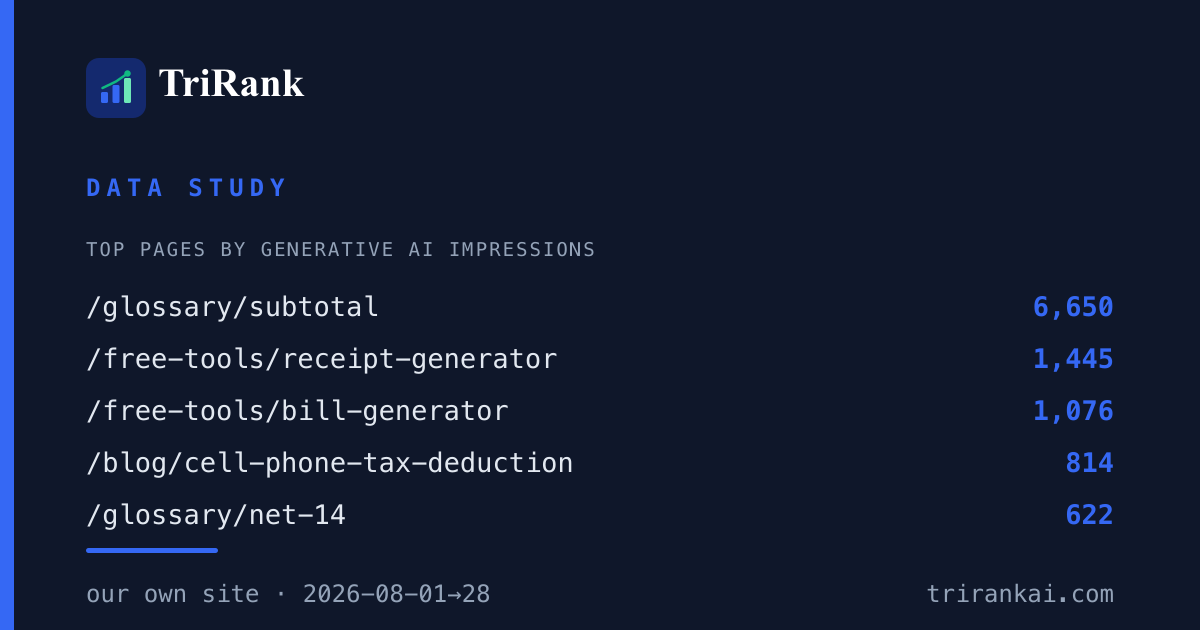
Google's Generative AI Report, Next to a Citation Sweep of the Same Site
Google now reports which pages it showed inside generative AI features. We put that export beside our own multi-engine citation sweep of the same site over the same 28 days — and the first thing worth saying is that the two denominators are nothing alike.
Self-Hosting Your SEO Stack: What It Actually Costs
Open-source SEO tools are having a moment, and self-hosting one is a real option. Here is the honest arithmetic: metered data fees, maintenance, a history that starts at zero, and one upstream you do not control.
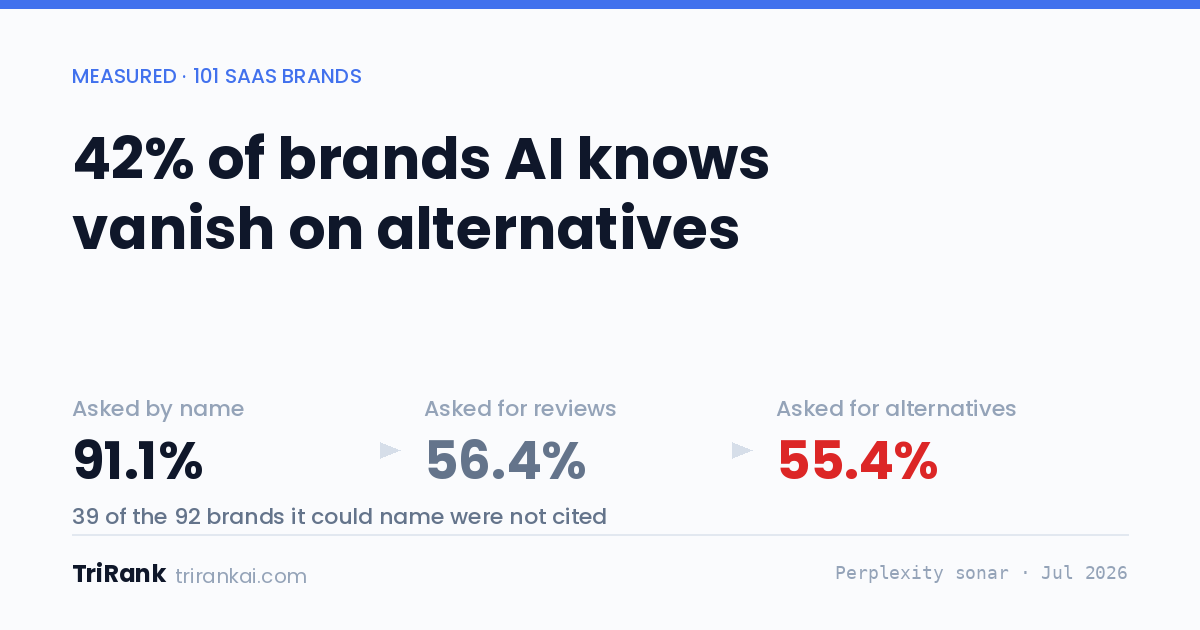
42% of Brands AI Knows By Name Vanish When You Ask for Alternatives
AI engines name 91% of SaaS brands asked directly. Ask the same engine for alternatives in that category and 42% of them disappear. Measured across 101 brands.
Newsletter
Join the community
Subscribe to our newsletter for the latest news and updates