Best AI Search Visibility Tools (2026)
A 2026 comparison of the best AI search visibility tools, with objective features and pricing, and where each one fits your team and budget.
本文目前只有英文版。站点其余部分已汉化,这篇内容尚未翻译。
The best AI search visibility tools are the ones that match how you work: some only monitor whether AI engines mention you, while others connect that visibility to the work of getting cited and report outcomes on real data. That distinction matters more than any feature list, because the category splits cleanly into tools that measure and tools that measure and act. This comparison lays out the leading options objectively, what each costs as of 2026, and who each one suits, so you can choose against your need rather than a marketing claim.
The reason to be deliberate is the size of the gap these tools address. Only 14% of brands currently track AI citations (Goodfirms, 2026), and roughly 90% of brands have zero presence in AI answers (Search Engine Journal, May 2026). The market is young and the tools are still differentiating, which means the right question is not "which tool is best" in the abstract but "which tool closes my specific gap at a price I can justify." Here is the lens for that decision.
What to look for in an AI visibility tool
Look first for four things: multi-engine coverage, citation-source analysis, continuous tracking, and a clear path from data to action. These are the criteria that separate a serious tool from a dashboard that looks busy, and they map directly onto how AI search actually behaves.
Multi-engine coverage matters because ChatGPT, Perplexity, Gemini, and Google's AI Overviews retrieve and compose answers differently. Growth Memo reported in May 2026 that 91% of sources appear in only a single engine, so a tool watching one assistant gives you a partial and possibly misleading read. Treat each engine as its own scoreboard.
Citation-source analysis matters because presence alone is half the story. Knowing you are absent is useful; knowing which competitor or review page is cited in your place is actionable. A tool that surfaces the credited URL turns "we're not showing up" into "this page is cited as the authority on our core question," which points at concrete work. Our background piece on AI search monitoring covers why this layer is the closest analogue to backlink data.
Continuous tracking matters because answers are volatile, with 40 to 60% of cited sources changing month to month (Ahrefs, November 2025). A snapshot goes stale fast, so the value lives in the trend line from scheduled, repeated runs.
The fourth criterion, a path from data to action, is where tools diverge most. Some stop at monitoring and leave the fix to you. Others connect each gap to the content or authority change likely to close it, and a few go further by executing that change and reporting the outcome on real performance data. That difference is the spine of the comparison below.
AI search visibility tools compared
The leading tools differ mainly in scope and price: monitoring-only tools cluster at the low end, while tools that add execution and outcome reporting cover more of the workflow. The table below summarizes the landscape as reported in 2026. Figures are as of 2026 and reflect publicly stated pricing and positioning rather than independent benchmarks.
| Tool | Reported pricing (2026) | Core focus | Engine coverage | Notable for |
|---|---|---|---|---|
| Otterly.ai | From ~$29/mo | AI mention and prompt monitoring | Multi-engine | Large reported user base (~20,000 users) |
| Peec AI | From ~$95/mo | AI visibility analytics | Multi-engine | Analytics-led monitoring |
| Profound | Enterprise-only, custom | Enterprise AI visibility | Multi-engine | Pulled back to enterprise (overkill below ~$2,000 budgets) |
| SEO Stack | ~$17k tier | Agency/enterprise SEO + AI | Multi-engine | High-end, agency-oriented |
| TriRank | From $49/mo (Starter) | Three-engine visibility + execution | SEO + AEO + GEO | Autopilot execution and GSC-real outcome reporting |
A second table is useful for separating what each tool does after it measures, because that is where the practical differences live.
| Tool | Monitors mentions | Citation-source analysis | Automated execution | Outcome reporting on real data |
|---|---|---|---|---|
| Otterly.ai | Yes | Partial | No | No |
| Peec AI | Yes | Yes | No | No |
| Profound | Yes | Yes | Limited | Enterprise |
| SEO Stack | Yes | Yes | Varies | Varies |
| TriRank | Yes | Yes (T2/T3 source analysis) | Yes (autopilot) | Yes (GSC-real, monthly archive) |
The pattern in both tables is consistent. The monitoring-first tools are capable and reasonably priced for what they do, which is tell you whether and how you appear. The differentiation at the higher-coverage end is whether a tool also does the work and proves the result. For a deeper look at the broader software landscape, our roundup of the best LLM SEO tools covers adjacent categories, and our Profound alternatives piece is useful if enterprise pricing has priced you out.
A word on how to read these figures, since the category is young and the numbers move. Pricing is taken from publicly stated plans as of 2026 and reflects entry tiers, not the cost of a full deployment; most tools add seats, prompt volume, or competitor slots at higher tiers, so the headline price is a floor rather than a quote. User counts, such as Otterly.ai's reported ~20,000, are company-stated rather than independently audited, and "engine coverage" means different things across tools, with some treating Google's AI surface as one engine and others splitting AI Overviews and AI Mode apart. The honest takeaway is to treat the table as a map of positioning, not a benchmark, and to validate any specific claim against your own use before committing budget. The volatility of the underlying surface, with 40 to 60% of cited sources changing month to month, also means a tool's value is in sustained tracking rather than a single impressive demo.
Who each tool suits
Match the tool to your situation, because each fits a different team, budget, and stage. None of these is wrong; they solve different problems.
Otterly.ai suits teams that want straightforward, affordable AI mention monitoring and value a mature, widely used product. With plans reported from around $29/mo and a large user base of roughly 20,000 as of 2026, it is a sensible entry point for a brand that mainly wants to know whether and how it is mentioned across engines without a heavier workflow. Our side-by-side on TriRank vs Otterly.ai walks through where that boundary sits.
Peec AI suits teams that want analytics-led visibility tracking and are comfortable starting from around $95/mo as reported. It leans into the measurement and analysis side, which fits a marketing team that has the in-house capacity to act on findings themselves once the tool surfaces them. TriRank vs Peec AI sets the two approaches against each other in detail.
Profound suits enterprises with dedicated budgets. Having reportedly pulled back from the low and mid market to enterprise-only custom pricing, it is overkill for teams working below roughly $2,000, but a fit for large organizations that need bespoke coverage and can absorb custom pricing. SEO Stack, at a reported ~$17k tier, similarly targets agencies and enterprises rather than individual mid-market brands.
TriRank suits mid-market teams that want more than monitoring at a mid-market price, with Starter from $49/mo. It fits a brand that not only wants to see its AI visibility gaps but wants those gaps worked on and the results reported on real data, without stepping up to enterprise contracts. The gap it targets is specific: teams large enough to have real AI visibility stakes but without a dedicated SEO and content function to act on a monitoring tool's findings, and without the budget to justify an enterprise contract. For that team, a tool that only reports problems creates a backlog rather than progress, because the constraint is execution capacity, not awareness. For smaller teams specifically, our guide to AI SEO tools for small business narrows the field further.
It is worth being explicit that these categories overlap at the edges. A small team with strong in-house content skills may be perfectly served by an inexpensive monitoring tool, while a mid-market team with no content bandwidth may get more value from a tool that executes even if its monitoring is comparable. The deciding variable is rarely the feature list in isolation; it is the match between what the tool does after it measures and what your team can realistically do on its own. Reading the two tables above through that lens, rather than as a scoreboard, is the most reliable way to avoid paying for capabilities you will not use or, more commonly, buying a dashboard whose findings then sit unworked.
Why TriRank is different: execution and real data
TriRank is different because it does not stop at monitoring; it executes the work and reports outcomes on real Google Search Console data, across three engines rather than one. Most tools in this category answer "are we visible?" TriRank is built to answer "are we visible, what should change, did we make the change, and did it move anything?" That is a larger loop, and it is the gap between a dashboard and a system.
The first difference is the three-engine model. TriRank treats traditional SEO, AEO (answer engine optimization), and GEO as one connected system, so a gap in AI answers is read alongside your search and answer-engine position rather than in isolation. Given that 91% of sources appear in a single engine (Growth Memo, May 2026), a one-engine view is structurally incomplete, and the three-engine frame is designed to avoid that blind spot. Our GEO vs SEO explainer covers why these engines need to be managed together rather than separately.
The second difference is autopilot execution. Where monitoring tools hand you a list of problems, TriRank's autopilot carries out the content and structural work that monitoring identifies, turning a visibility gap into a change rather than a to-do. This is the feature that separates measuring from acting, and it is the reason a mid-market team without a large in-house SEO function can close gaps that a monitoring-only tool would only surface.
The third difference is outcome reporting on real data. TriRank's reports are built on actual Google Search Console performance, not modeled estimates, with a monthly archive and exportable, white-label output. That means the result of the work is verifiable against your own real numbers, and the citation-source analysis includes T2 and T3 source breakdowns so you can see not just the obvious credited pages but the secondary and tertiary sources shaping an answer. The combination, real data plus a monthly archive plus white-label export, is what makes the loop auditable rather than anecdotal. For why monitoring on its own is necessary but not enough, see why use AI search monitoring tools.
How to choose
Choose by working backward from what you will do with the data. If you have the in-house capacity to act and only need to see clearly, a monitoring-first tool at the lower price points is a reasonable, honest choice. If you need the work done and the result proven, weigh tools that include execution and outcome reporting.
A short decision path: if your budget is enterprise-scale and you need bespoke coverage, the enterprise-only options fit. If you are a small team that mainly wants affordable mention tracking, the entry-level monitoring tools fit. If you are a mid-market team that wants visibility, execution, and verifiable results without enterprise pricing, that is the gap TriRank is built for. Pricing is one input; the deciding factor is how much of the workflow you want the tool to own.
Three questions sharpen the choice further. First, do you have the in-house capacity to act on findings? If not, weight execution heavily, because a monitoring-only tool will surface gaps faster than you can close them. Second, how many engines does your audience actually use? Given that 91% of sources appear in a single engine, single-engine tools understate your exposure, so multi-engine coverage is closer to a requirement than a nice-to-have. Third, will you need to prove results to someone? If a stakeholder will ask whether the spend worked, outcome reporting on real data, rather than modeled estimates, is the difference between an answer and a guess. Run any shortlist through those three questions and the field narrows quickly, usually to one or two genuine fits rather than the whole category.
It also helps to be wary of false precision. The AI surface is probabilistic, so any tool promising exact, ranking-style numbers for a question that returns different sources on different runs is overstating what the data can support. Honestly reported trends, with the volatility acknowledged, are more useful than a confident single figure that will not hold up next month. A good tool tells you how stable a finding is, not just what it found.
The fastest way to test any of this is on your own results rather than a feature list. A TriRank free audit runs a representative question set across the major AI engines and shows where your brand is named, where it is missing, and which pages are cited in your place, so you can judge any tool, including ours, against what it actually reveals. If you want to compare plans directly, the pricing page lays out where Starter and the higher tiers sit.
FAQ
What is the best AI visibility tool?
The best AI visibility tool depends on whether you only need to monitor or also need to act. Monitoring-first tools such as Otterly.ai (from ~$29/mo) and Peec AI (from ~$95/mo) are strong if you have the in-house capacity to act on findings yourself. If you want visibility plus execution and outcome reporting on real data without enterprise pricing, TriRank (from $49/mo) is built for that mid-market gap. There is no single winner; match the tool to how much of the workflow you want it to own.
How much do AI search visibility tools cost?
As of 2026, reported pricing spans a wide range. Entry-level monitoring starts around $29/mo (Otterly.ai), analytics-led tools around $95/mo (Peec AI), and TriRank's Starter from $49/mo. At the high end, SEO Stack sits around a $17k tier and Profound has moved to enterprise-only custom pricing, which is overkill for teams working below roughly $2,000. Cost tracks scope: monitoring-only tools cluster at the low end, while tools that add execution and reporting cover more of the workflow.
Is a free AI visibility tool enough, or do I need a paid one?
A free check is enough to answer the first question, whether your brand appears in AI answers, but not to track change over time or act on it. Because 40 to 60% of cited sources change month to month (Ahrefs, November 2025), a one-off free snapshot goes stale quickly, and roughly 90% of brands sit at zero presence (Search Engine Journal, May 2026), so most teams find a real gap that needs ongoing work. A free audit is the right way to see your starting point; continuous tracking and execution are what a paid tool adds.
作者

分类
更多文章
Why Use AI Search Monitoring Tools
Most brands have zero AI mentions and never know it. Here is why AI search monitoring tools matter, what they detect, and how to track visibility.
AthenaHQ Alternatives in 2026 (Source-Checked Pricing)
AthenaHQ alternatives compared on what each vendor publishes on its own pages. Athena's plans read August 31, 2026 — Free, Starter $295/month, Enterprise custom — with Otterly.ai, Peec AI, Profound and TriRank beside them, every figure dated.
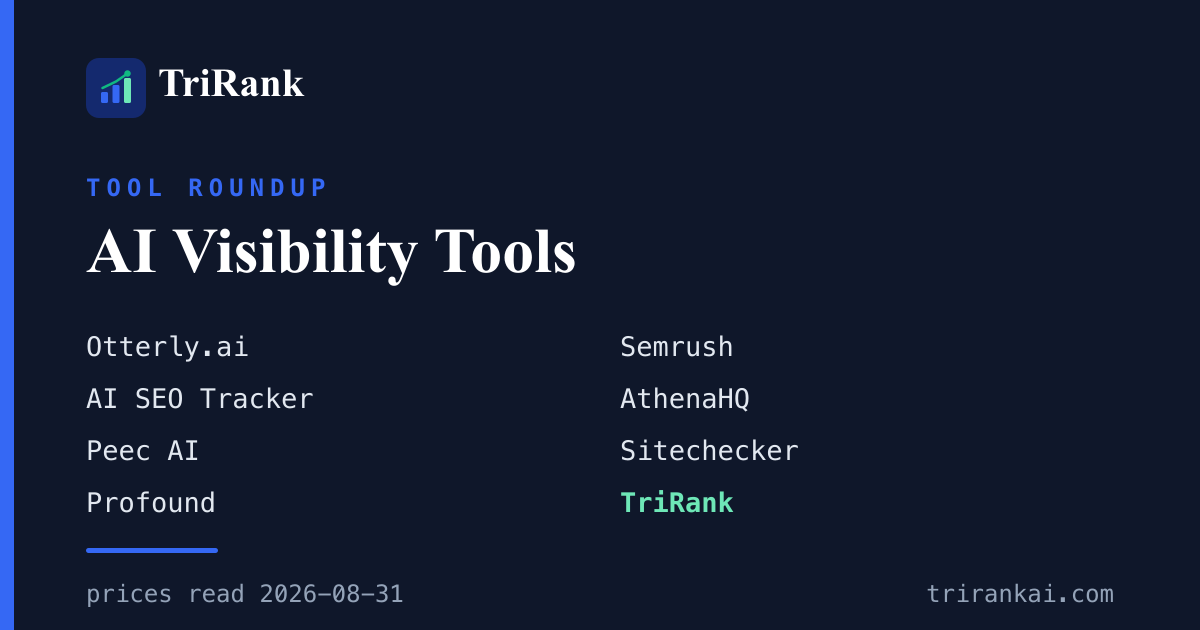
Best AI Visibility Tools (2026), With Every Price Read on One Day
Eight AI visibility tools compared only on what their own pages say, with every figure carrying the date we read it. Prices read 2026-08-31, ordered by lowest published monthly price, not ranked.
邮件列表
加入我们的社区
订阅邮件列表,及时获取最新消息和更新