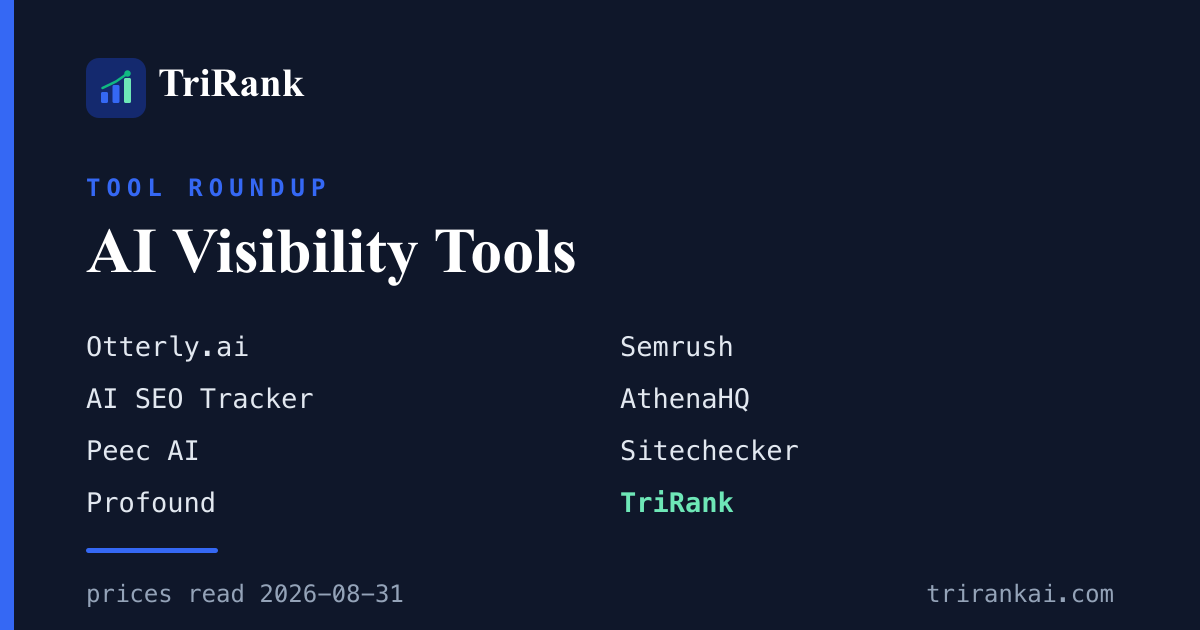
Best AI Visibility Tools for Indie Sites and Small SaaS (2026)
Compare AI visibility tools for small SaaS by billing unit, engines, Search Console, and missing-data handling, with source-dated pricing.
本文目前只有英文版。站点其余部分已汉化,这篇内容尚未翻译。
For a 2–10 person SaaS, an AI visibility tool is useful if it records whether answer engines cite your domain on a fixed prompt set, shows which domains were cited instead, and never treats an unmeasured reading as zero. Prefer tools that also connect Google Search Console so you can separate classic search clicks from AI citations.
The best purchase depends on the work you will actually do after a check. A founder investigating one omission needs a different setup from an agency producing daily client reports. Start with a small, stable set of buying questions and a reviewable answer record. Add broader coverage when it changes a decision, rather than buying the largest model count before you have a baseline.
Disclosure: TriRank is our product. This guide compares public documentation read on October 29, 2026, not paid accounts tested against an independent accuracy benchmark. Recommendations below are purchasing judgments, not measured rankings. Unverified integration or missing-data behavior is left unverified.
Who this guide is for
This guide is for an owner or marketer choosing a first repeatable AI citation workflow. You have a working site, a defined customer, and at least a few questions that could lead someone to your product. You want to learn where answers cite your domain and what useful work to do next.
Skip this buying process for now if the site is inaccessible, the product proposition is still changing every day, or nobody can act on the findings. Likewise, a team requiring procurement controls, contractual service levels, or managed international research should evaluate those requirements directly. An inexpensive tracker is not automatically a substitute for an enterprise program.
How we evaluated the options
We used five questions rather than a numerical score. What is the billing unit? Which engines are included in the actual plan? Is a Search Console connection documented? Can a reader inspect citations separately from mentions? What happens when the system cannot obtain an answer?
A mention names your brand; a citation links to a source. A tool can report both, but the metrics answer different questions. A missing observation is neither a successful citation nor a measured absence. We could not establish every competitor's failure-state policy from public pages, so the table does not award TriRank an invented accuracy advantage.
The final question is whether there is a low-commitment starting point. A free sample, a trial, and a recurring free plan are different offers. Check cancellation terms, required billing details, exports, and the amount of history you keep when a trial ends.
Comparison table
Prices below are source-dated observations, not guaranteed checkout quotes. “Not verified” means we did not establish the behavior; it does not mean the vendor lacks it.
| Product | Price and billing unit | Engines covered in the stated scope | GSC connection | How missing data is shown |
|---|---|---|---|---|
| Profound1 | Free seven-day trial; ongoing Enterprise quote; prompts plus agent credits | Trial: ChatGPT, Gemini, Google AI Overviews; Enterprise up to nine | Not verified from pricing | Not verified |
| Peec AI2 | Starter $95/month; 50 prompts, three active models | Three selected models; confirm the exact selection | Not verified | Not verified |
| OtterlyAI3 | Lite $29/month; 15 prompt slots | ChatGPT, Perplexity, AI Overviews, Copilot; other engines are add-ons | Not verified | Not verified |
| HubSpot AEO4 | Standalone $50/month, 25 prompts; $45/month annual equivalent | ChatGPT, Gemini, Perplexity | AEO-specific join not verified | Not verified |
| Scrunch5 | Core $250/month in the dated snapshot; prompt/response and workspace limits apply | Core: ChatGPT, Perplexity, AI Overviews, Copilot; quoted SKU should match | Not verified | Not verified |
| Goodie6 | Core $295 displayed; billing basis not verified from dated extract; 110 prompts | Core: ChatGPT, AI Overviews, Perplexity, AI Mode, Copilot; broader tiers differ | Listed in official integrations | Not verified |
| Rankscale7 | Pro $99 monthly; 1,200 execution credits | 17+ advertised; engine-dependent costs | Not verified | Not verified |
| AthenaHQ8 | Starter $295/month; 3,600 credits | 11 models listed on Starter | Official integration documented; check access | Not verified |
| TriRank, ours9 | Starter $49/month; subscription with content credits and a separate probe allowance | Paid monitor roster in the snapshot: ChatGPT, Perplexity, Gemini, Claude, Google AI Overviews; check availability | Yes | Unknown is distinct from a valid uncited result |
Sources, all read October 29, 2026: Profound, Peec, Otterly, HubSpot, Scrunch, Goodie, Rankscale, AthenaHQ plans, AthenaHQ integrations, TriRank pricing, and TriRank methodology.
Which tool fits which job?
Profound for evaluating a broader organizational program
Consider Profound when the decision includes shared research, agents, procurement, and organization-wide reporting. Its current brand pricing page presents a trial followed by a custom offer. Do not budget from old $99 or $399 plan screenshots: they are not the current public offer we read. Ask for the ongoing package and export rights before moving a trial into your reporting routine. Profound pricing, read October 29, 2026.
Skip this option for now if a custom ongoing package is not a commitment you are ready to evaluate.
Peec AI for daily prompt-based analytics
Peec's entry footprint is relevant when you want daily monitoring across a selected set of models. Compare the selected models with your buyers' actual needs; a vendor's overall supported list is not the same as the engines enabled in your plan. Verify geography and project allocation as well as the headline prompt count. Our existing vendor comparisons provide a starting point for a narrower shortlist. Peec pricing, read October 29, 2026.
Skip this scope if your essential engine or geography is not included in the selected plan.
OtterlyAI for a small recurring question set
Otterly's Lite footprint is worth evaluating if a small prompt set on its documented base engines covers the immediate job. Ask whether Claude, Google AI Mode, or Gemini is required, since the dated pricing snapshot lists them as add-ons. A lower entry price is useful only when the included scope matches the review you intend to run. Otterly pricing, read October 29, 2026.
Skip the base-only budget if your required engines need extra add-ons.
HubSpot AEO for teams already organizing marketing there
The supplied HubSpot AEO extract emphasizes CRM/Marketing Hub context alongside its standalone subscription. That is a reason to evaluate it if customer context already lives there. Separate the standalone AEO product, the larger marketing offer, and a free grader. They are not interchangeable subscriptions. Ask whether the standalone option includes the workflow you intend to use. HubSpot AEO, read October 29, 2026.
Skip the wider-suite assumption if you only intend to buy the standalone AEO entitlement.
Scrunch for monitoring and site audits
Scrunch's dated pricing snapshot combines recurring monitoring with a defined site-audit allowance. Evaluate it if prompt and response volume, workspace access, and site review belong to the same buying job. Ask what happens after an audit identifies a problem and which actions require another entitlement. Do not assume every capability advertised elsewhere is bundled in Core. Scrunch pricing, read October 29, 2026.
Skip purchase until the quoted plan and implementation responsibilities are clear.
Goodie for a documented research and action stack
Goodie is worth reviewing when integrations and follow-through matter alongside citation tracking. The dated extract describes prompts, model coverage, Search Console integration, and MCP optimization-action allowances. If attribution is part of your buying brief, ask for separate evidence of that capability rather than inferring it from an integration. Ask what data reaches an editor, what needs approval, and which capabilities belong to your quoted tier. Goodie product site, read October 29, 2026.
Skip a broader action program if nobody on the team can review and use the proposed work.
Rankscale for controlling execution through credits
Rankscale makes the execution budget an explicit part of planning. This is useful when you want to vary model selection or cadence, provided you calculate the resulting credit use. A saved question library does not mean unlimited answers. Build the exact question, engine, repeat, and schedule combination in its calculator before comparing an allowance with a fixed-prompt subscription. Rankscale pricing, read October 29, 2026.
Skip a credit-based setup if you cannot define or control the intended execution budget.
AthenaHQ for a wider monitoring and action evaluation
AthenaHQ's published plans combine credits with a larger model roster, and its dated pricing extract documents Search Console. Evaluate it when those capabilities are relevant to the same owner rather than separate items on a checklist. Confirm how credits translate into completed responses, and whether the actions you need are included, permissioned, or additional services. AthenaHQ integrations, read October 29, 2026.
Skip a larger model roster if the additional observations do not inform a decision.
TriRank for connecting site evidence to reviewed content work
TriRank fits a team that wants Search Console evidence beside observed citations and a draft-based content workflow. It supports work destined for WordPress, Ghost or Webflow, with a human responsible for publishing. Starter's 30 registered prompts are not a promise of 30 daily responses on every engine. Monitoring cadence and successful completion matter, and monitoring has a separate allowance from content credits. Start with the sample audit to see whether the output helps you make a page-level decision. TriRank pricing and methodology, read October 29, 2026.
An indie buying path that keeps the experiment useful
First, run a free check to understand the output. TriRank's public checker accepts a brand and domain; it is not a replacement for a configurable recurring ten-question test. A bare-brand check can reveal sources, but cannot establish how an entire category's buyers will discover you.
Next, write ten questions drawn from customer conversations: a mix of problem, category, comparison, and use-case decisions. Ten is an illustrative starting scope, not a statistically sufficient sample or an advertised free allowance. Freeze the wording, locale, engine selection, and schedule before collecting a baseline.
Then connect Search Console if you have access to the property. Keep its Google impressions and clicks beside the citation observations, with separate denominators. Do not infer ChatGPT traffic from GSC, or infer sales from a cited URL. Record which source page you will improve and who owns the change.
Finally, review whether the system helped you complete useful work. Did you understand a result, choose a page, prepare a defensible edit, and return to check the same question? If not, more prompts may increase the reporting burden without resolving the buying problem.
Questions to ask in a trial
Ask for one completed answer, one failed request, and one unsupported or unavailable engine state. Inspect whether citations have usable source URLs, whether the timestamp and prompt are visible, and whether a failure lowers the headline score. A single attractive dashboard is not enough to establish the denominator.
Use the same criteria for every candidate, including TriRank. Record time spent interpreting results and preparing changes. This does not produce an accuracy league table, but it tells your team which workflow it can sustain. Keep your first review small enough that one person can finish it without abandoning their other marketing work.
Read a product-centered review
For deeper evaluation questions and a source-dated price record, see our reviews of OtterlyAI, Peec AI, Profound, Scrunch, Goodie, Rankscale, AthenaHQ and HubSpot AEO. These are official-source desk reviews, not paid-account tests.
FAQ
Skip TriRank if you require an enterprise feature or collection method it has not demonstrated.
Is the cheapest monthly price the best value?
Only if its included scope covers your actual questions, engines, countries, and review cadence. Include add-ons and human review time. Compare a recurring plan with a recurring plan, not with an expired trial or an annual-equivalent headline.
Does an AI visibility score show my rank in every chat?
No. It summarizes a defined set of observations under a vendor's rules. Model versions, wording, location, interface, and time can change the answers. Inspect the underlying record and the definition of the score.
Can a citation tracker prove that AI search produced revenue?
A citation establishes that a source was attached to an observed answer. Revenue needs separate analytics and conversion evidence. Even a recorded referral or assisted signup does not by itself establish incremental revenue caused by the citation.
Does TriRank make answer engines cite a website?
No. It measures observed citations and supports content work. Developer API probes are related to, but not identical to, consumer apps; live Google surfaces are measured separately. Availability and unknown results remain part of the interpretation.
Start with an inspectable result
Try the free AI Visibility Checker, inspect the live dashboard demo, and read the measurement methodology. Choose a paid workflow when you know which question set you need and what action a result should support.
Footnotes
-
Official pricing/product source, official pricing snapshot read October 29, 2026; unverified cells remain unverified. ↩
-
Official pricing/product source, official pricing snapshot read October 29, 2026; unverified cells remain unverified. ↩
-
Official pricing/product source, official pricing snapshot read October 29, 2026; unverified cells remain unverified. ↩
-
Official pricing/product source, official pricing snapshot read October 29, 2026; unverified cells remain unverified. ↩
-
Official pricing/product source, official pricing snapshot read October 29, 2026; unverified cells remain unverified. ↩
-
Official pricing/product source, official pricing snapshot read October 29, 2026; unverified cells remain unverified. ↩
-
Official pricing/product source, official pricing snapshot read October 29, 2026; unverified cells remain unverified. ↩
-
Official pricing/product source, official pricing snapshot read October 29, 2026; unverified cells remain unverified. ↩
-
Official pricing/product source, official pricing snapshot read October 29, 2026; unverified cells remain unverified. ↩
作者

分类
与本文相关的免费工具
更多文章
OtterlyAI Alternatives: Monitoring and Content Work
OtterlyAI alternatives compared on current plan units, model add-ons, reporting and site workflows. Includes dated sources and honest TriRank trade-offs.
Peec AI Alternatives for Analytics and Content Work
Compare Peec AI alternatives by prompts, projects, model access and workflow. Current prices are marked unverified where extraction could not confirm them.

Alternatives to Index Coverage: Better Ways to Monitor Your Site's Search Visibility
Discover the best alternatives to index coverage reporting, from log file analysis and AI SEO tools to the URL Inspection API and site crawl platforms.
邮件列表
加入我们的社区
订阅邮件列表,及时获取最新消息和更新