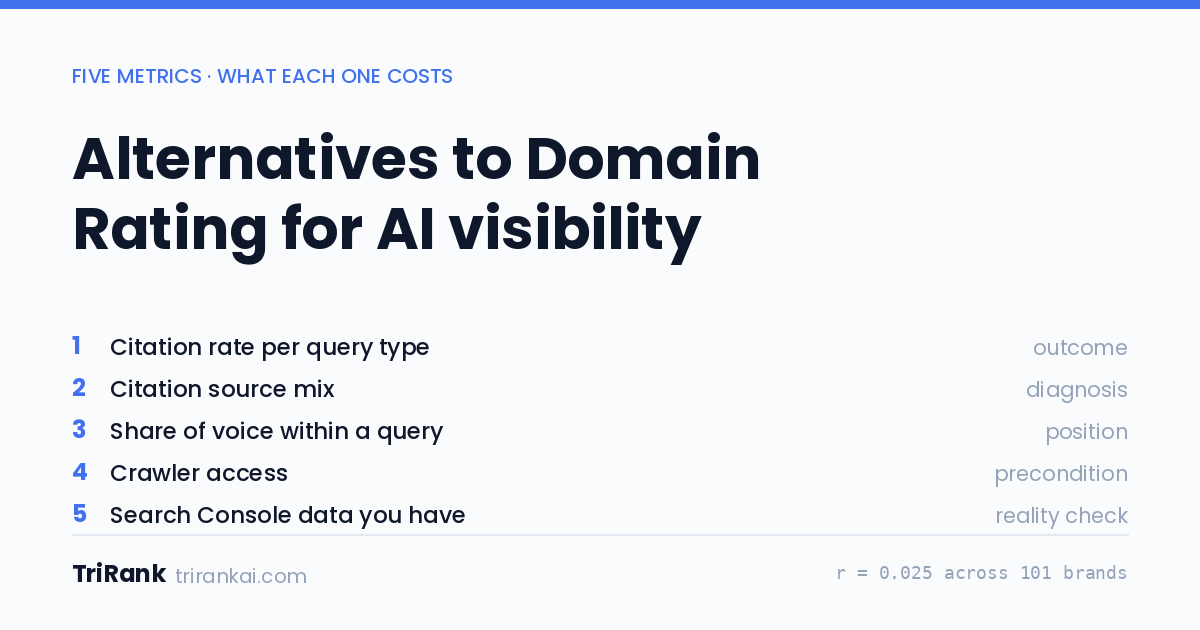
Alternatives to Domain Rating for Judging AI Visibility
Domain Rating showed no detectable link to AI citations across 101 brands. Here are five metrics that do measure it, what each costs, and where each one breaks.
We crossed Ahrefs Domain Rating against AI citation rates for 101 SaaS brands and found no detectable relationship — Pearson r = 0.025, with the highest-DR band cited less often than the lowest. The full argument, including the three reasons it might be wrong, is in high Domain Rating buys you nothing in AI answers.
That leaves an obvious question, and this post is only about the question: if not DR, then what?
Fair warning up front — there is no clean substitute. Domain Rating has one vendor, one definition and a decade of shared usage behind it. Nothing on this list has that. What follows is five things that actually measure some part of AI visibility, with what each one costs you and where each one breaks.
Why the substitute is hard
Domain Rating is one number that summarises one thing: who links to you. It works as a shorthand because link graphs are stable and one company defines the scale.
AI visibility has none of those properties. It varies by engine, by query, by week, and no vendor's definition binds anyone else's. So the honest replacement is not one number — it is a small set, and you have to say which engine and which date every time.
The same trap catches Domain Rating's own competitors: Moz's Domain Authority measures a similar idea on a different scale, and the two disagree on the same site. We wrote up why in Domain Rating vs Domain Authority. Swapping one domain-level score for another does not solve anything here.
1. Citation rate per query type
What it is. The share of questions on which an engine's structured citations include your domain — split by the kind of question.
This is the metric our own data is built on, and the split is the important half. In our July 2026 run, the same 101 brands scored 91.1% when asked about by name and 55.4% when the engine was asked for alternatives in their category. One number averaged across both would have hidden the entire finding.
What it costs. Engine calls, one per query per brand. This is the expensive one on the list.
Where it breaks. It is only as good as your query set. Three prompts per brand — our own sampling — means a brand's rate can only take four values: 0, 0.33, 0.67 or 1. That is coarse, and we say so on the benchmark page rather than letting the precision of "55.4%" imply otherwise.
2. Citation source mix
What it is. Not whether you are cited, but what the engine cited instead.
Across our 2,469 citations, brands' own domains took 10.2% of the total. Reddit took 9.1% and appeared for 98 of the 101 brands. YouTube took 8.0%; G2 3.9%.
That mix is diagnostic in a way a score is not. If the engine answers questions about your category from community threads and you have no presence in them, you now know the specific gap rather than a number that went down.
What it costs. Nothing extra — it comes out of the same run as metric 1.
Where it breaks. Shares, not counts. And a threshold: we only publish a source once it appears across five or more different brands, so one company's unusual footprint cannot masquerade as a trend. Full table on the citation sources page.
3. Share of voice within a query
What it is. When an engine answers a category question, how often are you among the brands it names, versus your competitors.
DR compares you to the whole web. This compares you to the three or four names that actually appear in the answer a buyer reads — which is the comparison that decides anything.
What it costs. Same engine calls, plus the work of maintaining a competitor set.
Where it breaks. The competitor set is a judgement call, and it moves. Definitions in AI search visibility metrics and KPIs.
4. Crawler access
What it is. Whether the AI crawlers can reach your pages at all — robots.txt rules, JS-dependent rendering, login walls.
This one is a precondition, not an outcome. It cannot tell you that you are visible; it can tell you that you have made visibility impossible, which is worth checking before you spend anything on the rest.
What it costs. Nothing. It is a file and a fetch.
Where it breaks. Passing means nothing on its own — a perfectly crawlable site can still be cited by nobody. And the crawler tokens are vendor-defined: OpenAI publishes three separate ones with different purposes, Anthropic documents its own, and Google keeps a full list. Treating them as one thing produces a number that means nothing. Definitions: robots.txt, llms.txt.
5. Search Console data you already have
What it is. Impressions, clicks and average position from Google Search Console.
Not an AI metric — but it is real, free, specific to your site, and most teams reading a Domain Rating chart are ignoring it. Google's own AI features documentation is the other half of the picture: what surfaces in AI answers is a content-and-eligibility question, and Search Console is the only free view of how your content is doing on the classic side of that.
What it costs. Nothing.
Where it breaks. It says nothing about ChatGPT, Perplexity or Claude. It is one input, not the answer.
Putting the five together
| Metric | Measures | Cost | Biggest weakness |
|---|---|---|---|
| Citation rate per query type | Outcome | High | Only as good as the query set |
| Citation source mix | Diagnosis | Free with #1 | Shares, not counts |
| Share of voice | Competitive position | High | Competitor set is a judgement |
| Crawler access | Precondition | Free | Passing proves nothing |
| Search Console | Classic search reality | Free | Silent on AI engines |
If you take one: citation rate per query type, split by query intent. It is the only one measuring the outcome, and splitting it is what makes it honest.
If you take two: add citation source mix, because it turns a bad number into a specific gap.
What we are not claiming
Domain Rating is not broken and we still track it — our own is 23, and it is Ahrefs' number, published under their name. Link authority still moves classic rankings.
And none of the five above has an agreed cross-vendor definition. Two tools reporting "AI visibility score" are reporting two different measurements with the same label. Until that settles, the only defensible thing to do is publish your method — which is what we do on the benchmark page, and why we wrote down our measurement rules.
Related reading
The finding this post follows from: high Domain Rating buys you nothing in AI answers. Its Google-side counterpart: why ranking on Google doesn't get you cited by AI. Practical checks: how to check AI search visibility. Tool landscape: best AI search visibility tools and best AI search monitoring tools. A near-identical exercise for a different metric: alternatives to index coverage.
Definitions: Domain Rating, Domain Authority, Domain Rating vs Domain Authority, AI search visibility, LLM visibility.
FAQ
Should I stop tracking Domain Rating? No. Domain Rating summarises link authority and still tracks with classic search performance. The narrower point is that it did not predict AI citation in our sample of 101 SaaS brands, so it is the wrong dial for that specific goal.
What is the single best replacement metric? Citation rate per query type — the share of buyer-intent questions on which an engine cites your domain. It is the only metric in this list that measures the outcome rather than a precondition, and it is the one our own data is built on.
Do any of these alternatives have a vendor-agreed definition? No, and that is the honest state of the category. Domain Rating has one authority behind it. AI-visibility metrics do not yet, so anyone comparing two vendors' numbers is comparing two different measurements with the same label.
Free tools for this
More Posts
Best Outrank Alternatives in 2026 (Source-Checked Pricing)
Five Outrank alternatives compared on what each vendor actually publishes: SEObot, Otterly.ai, Peec AI, Profound and TriRank. Every price checked in a live browser in July 2026 — or marked as not published.

Profound Alternatives for Enterprise Teams (Source-Checked Pricing)
Profound alternatives for enterprise teams, compared on what each vendor actually publishes. Profound's pricing page re-read August 29, 2026: Starter $99/month, Growth $399/month, Enterprise still Custom. Peec AI, Otterly.ai and TriRank beside it, every figure dated.
AI Search Monitoring Tools
Compare AI search monitoring tools by engines, prompt cadence, citations and reporting. Learn how to turn a visibility check into a page-level action.
Newsletter
Join the community
Subscribe to our newsletter for the latest news and updates