High Domain Rating Buys You Nothing in AI Answers
We crossed Ahrefs Domain Rating with AI citation rates for 101 SaaS brands. The highest-DR band is cited least often. Here is the data and its limits.
Ahrefs Domain Rating is the number most teams reach for when they want a single answer to "how strong is this site". It is a good number. It is also, as far as we can measure, useless for predicting whether an AI answer engine will cite you.
We can say that with a specific dataset rather than a hunch, so this post is mostly the dataset — including the three reasons it might be wrong.
What we crossed
Two things we already publish, joined on the domain:
- AI citation rate — our AI visibility benchmark of 101 well-known SaaS brands. Each brand was asked three questions, and we recorded whether the brand's own domain appeared in the engine's structured citations. Collected July 2026 on Perplexity (sonar).
- Domain Rating — the SaaS DR leaderboard, the same 101 domains, snapshot dated 2026-08-05. Domain Rating by Ahrefs.
Those are two different dates a month apart, and we keep them labelled separately everywhere they appear. Ahrefs' own definition of Domain Rating is worth reading if you have not: it is a 0–100 logarithmic score built from the backlink profile, and nothing in that definition mentions answer engines.
The result
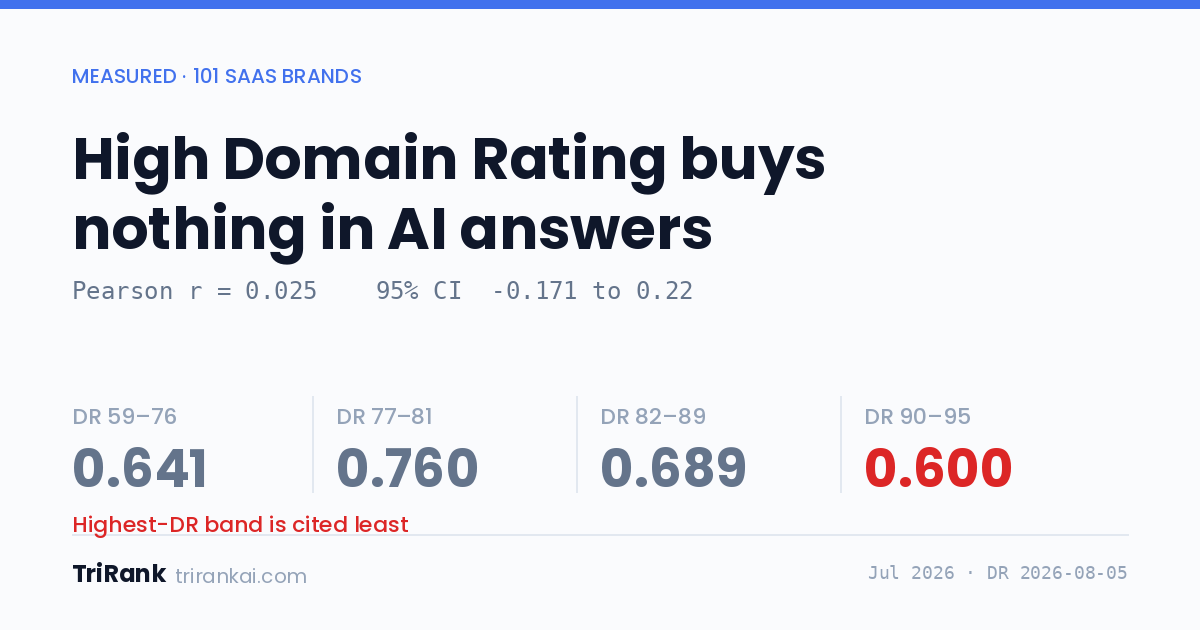
Sorted into four bands by DR value, the share of prompts each band was cited on barely moves — and the top band sits below the bottom one.
| DR band | Brands | Mean citation rate |
|---|---|---|
| DR 59 – 76 | 26 | 0.641 |
| DR 77 – 81 | 25 | 0.760 |
| DR 82 – 89 | 30 | 0.689 |
| DR 90 – 95 | 20 | 0.600 |
Across all 101 brands, the Pearson correlation is r = 0.025, with a 95% interval of -0.171 to 0.22. That interval contains zero comfortably. The strongest-authority quintile of this list is not the most-cited quintile; it is the least.
How the bands were cut, and why that matters
The bands are cut on the DR value, not on rank. Each band takes every brand above the previous band's top DR, up to and including its own. That keeps brands with identical DR in the same band — ten of these 101 domains share DR 81 — at the cost of unequal band sizes.
This choice changes a number you are looking at. Split the same 101 brands into four equal-sized groups by rank instead, and the top band's mean moves from 0.600 to 0.641. The headline "the top band is lowest" survives either way, but the specific figure does not, so we publish the cut points rather than implying them. You can check the arithmetic against the live version of this table.
Three limits, carried at the same weight as the finding
This is the premise our product rests on, which is exactly why the limits belong next to the result rather than in a footnote.
The sample contains no weak domains. It runs from DR 59 to DR 95; 62 of the 101 sit at DR 80 or above. So the finding is that among domains that are already strong, Domain Rating does not predict AI citation. It is not evidence that DR and AI visibility are unrelated in general — this run has no low-authority domains to say that with.
The measurement is coarse. Each brand was asked three prompts, so its citation rate can only take four values: 0, 0.3333, 0.6667, or 1. A scale that blunt attenuates any correlation on its own, before the underlying relationship gets a say.
The sample can only see so far. At n = 101, this data can detect a correlation of |r| = 0.276 at 80% power. Our 0.025 is far below that. The honest reading is "no relationship detectable here", not "no relationship exists". The upper end of the interval still reaches 0.22.
One more boundary worth stating: all of it comes from a single engine. Perplexity's sonar model family returns structured citations, which is what makes this measurable at all — but a result from one engine is a result from one engine.
Why this is not surprising once you look at what gets cited
Domain Rating summarises who links to you. AI answers are assembled from what an engine can retrieve and quote at answer time, and Google's own documentation on AI features describes that as a content-and-eligibility question, not a scoring one.
Our source data agrees. Across all 2,469 citations in that July run, only 10.2% pointed at the brand's own domain. Reddit took 9.1% and appeared for 98 of the 101 brands; YouTube took 8.0%. The strongest domain in the world does not help when the engine's answer is assembled out of a forum thread and a video.
That is also the practical version of what Google says about creating helpful content: the thing being evaluated is the page, not the domain's reputation score.
What to do with this
Not "ignore Domain Rating". Link authority still moves classic rankings, and our own DR is 23 — we are not writing this from a position of comfort.
The point is narrower: if your goal is being cited in AI answers, Domain Rating is not the dial. Track whether engines actually name and cite you, per query, over time. We wrote up which metrics survive that shift in AI search visibility metrics and KPIs, and the mirror-image finding — that ranking #1 on Google does not transfer either — is in why ranking on Google doesn't get you cited by AI.
If you want the shorter version of what DR is and is not, the Domain Rating glossary entry covers the definition, and Domain Rating vs Domain Authority covers why two vendors give the same site two different scores. For what to watch instead, we put the alternatives in one place.
And if you would rather not take our word for the shape of the data: the benchmark page publishes the bands, the cut points, the confidence interval and the power calculation. Checking us is the point.
FAQ
Does Domain Rating affect whether AI engines cite you? In our measurement of 101 SaaS brands, no relationship was detectable. The Pearson correlation between Domain Rating and citation rate was 0.025, with a 95% interval from -0.171 to 0.22. Every domain in that sample already sat between DR 59 and DR 95, so the finding applies to strong domains — it is not evidence that Domain Rating is irrelevant everywhere.
What does a correlation of 0.025 actually mean? It means the two numbers moved together no more than chance would produce. With 101 brands, the smallest correlation this sample could reliably detect at 80% power is 0.276. So the result rules out a moderate or strong relationship and leaves a weak one possible.
If Domain Rating does not predict citations, what does? Our own data points at content shape and third-party footprint rather than link authority: 9.1% of all citations went to Reddit and 8.0% to YouTube, while brands' own domains took 10.2% of the total. The engine is reading what other people wrote about you at least as often as what you wrote.
Free tools for this
More Posts
Which SaaS Categories AI Actually Recommends (13 Categories, Measured)
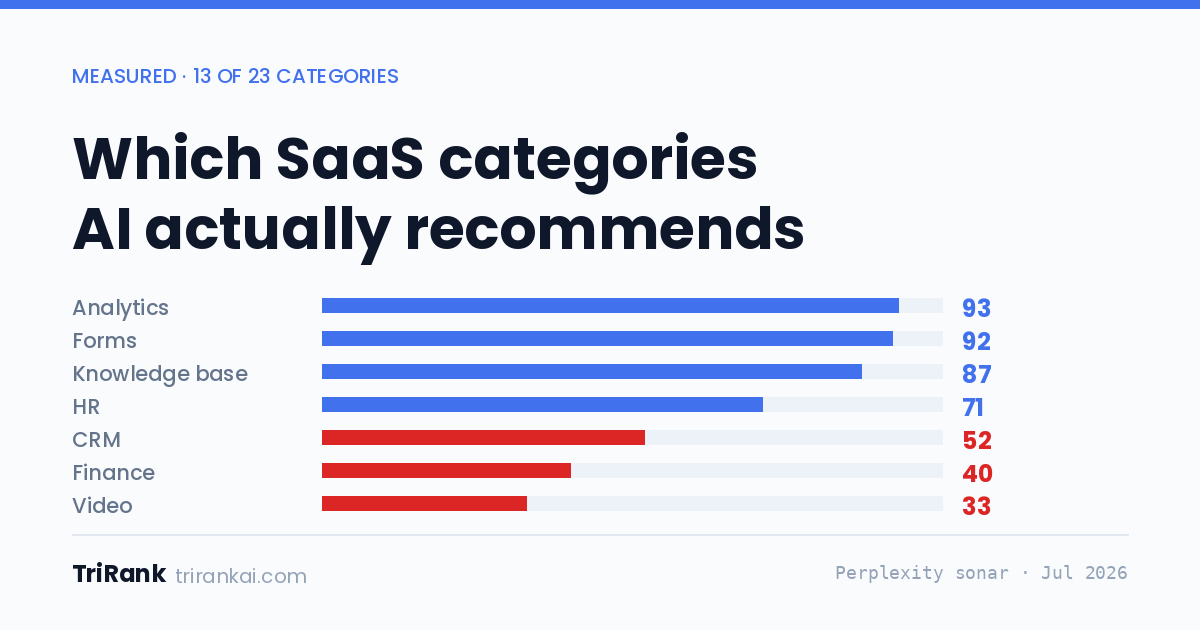
Analytics tools score 93 out of 100 on AI visibility. Video tools score 33. We measured 13 SaaS categories on the same three questions in July 2026.

Why Ranking #1 on Google Doesn't Get You Cited by AI (833 Keywords, 831 Never Checked)
A site we own ranked on page one for 833 Google keywords as of 2026-08-12 — and 831 of them had never been checked against a single AI engine. Why Google rankings don't transfer to AI answers, and why 'not cited' and 'not checked' are different findings.
AI SEO Statistics (2026)
The AI SEO statistics that matter in 2026: market size, conversion, citation mechanics, zero-click, and the monitoring gap, each with its source.
Newsletter
Join the community
Subscribe to our newsletter for the latest news and updates