GSC AI Data and Citation Probes: A Practical Reading Workflow
Read Google Search Console data beside AI citation probes without mixing reports, windows, or denominators. A practical workflow with clear measurement limits.
Search Console and AI citation probes answer different questions. Google's data describes a property's performance within the report and filters available to that property. Separate probes of ChatGPT, Perplexity, Claude, Gemini, and Grok observe whether those systems cite your domain on recorded questions. Use both where available; do not treat one as a proxy for the other.
Start by naming the actual Google report. Google's general documentation currently describes AI Overviews and AI Mode within overall Web performance. An account-specific or historical generative AI export must retain its own schema and limits. The existence of such an export for one property does not establish universal access to a separate report.12
This workflow shows how to put evidence side by side without manufacturing a combined visibility score. TriRank is our product. Documentation was read on October 29, 2026. No new GSC export or production citation study was collected for this guide.
What your Google report actually contains
Open Search Console and record the property, report name, date window, search type, country, device, and grouping. Then inspect the fields the actual report exposes. A familiar-looking chart is not enough to establish what its rows mean.
In the general Search results report, the available metrics and dimensions have defined meanings. Property-level and page-level aggregations can differ, so a sum of page rows need not reproduce the chart total. Preserve the grouping when explaining a number instead of treating disagreement as a broken export.3
For a report specifically labeled generative AI features, preserve that identity and its schema. Do not assume it contains queries or clicks just because another GSC report does. If a field is absent, the answer is “not available in this export,” rather than a reconstructed value presented as measured.
A spreadsheet cell also needs context. Google's performance documentation notes that unavailable values can become zeros in an export. Therefore, a numeric zero is not sufficient by itself to establish an observed absence. Keep the source report and its availability rules with the exported data.3
What an AI citation probe measures
A probe starts with a recorded question and a specified engine interface. It preserves an answer and the source evidence that interface returns, then evaluates whether the target domain appears in the citations. A brand name in the prose is a mention; a source URL is citation evidence. The two should remain separate.
TriRank's ChatGPT, Claude, Perplexity, Gemini, and Grok probes use developer APIs. These are related to, but not identical to, consumer applications. Its Google AI Overviews and AI Mode observations come from live results, which are a different collection method. Availability and the method used must accompany the finding.4
A completed answer with no matching domain is an observed uncited result under the matching rule. A provider failure, an unrun question, or unavailable usable evidence is not the same result. Keep that state visible and exclude unknown readings from a rate that claims to describe completed verdicts.
Compare scope before comparing outcomes
| Question | Google report | Citation probe |
|---|---|---|
| What was observed? | Performance within the selected Google report and grouping | An answer and returned source evidence for a recorded question/interface |
| Which question produced it? | Only if the actual report exposes the relevant query dimension | Exact configured question should be retained |
| Does it describe ChatGPT? | No | Only the recorded ChatGPT interface/run, not every user session |
| Does it prove a visit? | Only the corresponding measured click metric, if available | No; a citation is not a click |
| What is the denominator? | Defined by the report, filters, and aggregation | Defined by eligible completed observations and citation rules |
| What does missing mean? | Follow the source report's availability rules | Preserve unknown, unavailable, or unrun states |
Table sources, read October 29, 2026: Google documentation and TriRank's published methodology.134 These measures should not be added into a single percentage.
A side-by-side workflow for an owned site
1. Choose the page decision first
Select a page you can actually improve: a product explanation, comparison, integration guide, or answer to a recurring customer question. Write down what a reader needs from it. This makes the analysis less likely to turn into a search for whichever metric looks weakest.
For example, a founder could investigate whether an integration page explains setup requirements clearly. A GSC query can indicate how people find that page through Google. A citation probe can show which sources an answer uses for a related question. Neither establishes the reader's entire buying journey.
2. Preserve the Google view and its window
Export or record the actual report without changing filters midway. Keep a source identifier, extraction time, data cutoff, and the meaning of each field. Use equal-length windows for a comparison, with the same country, device, search type, and grouping when those dimensions are available.
Do not silently substitute all-country totals for a country-filtered page view. Do not compare query rows to a property-level baseline and describe the difference as a page gain. If the required slice is unavailable, record that gap and narrow the conclusion.
3. Define the probe set separately
Choose questions from real customer decisions, not just terms for which the site already appears. Include the exact wording, language, intended country, engine interface, and repeat schedule. Keep branded and unbranded questions in distinct groups because naming the brand changes the test.
Do not use Google's query list as proof that people ask exactly those questions in every AI app. It is a useful source of hypotheses, not a measurement of all AI demand. Likewise, a generated question list does not supply search volume or keyword difficulty.
4. Put page evidence next to source evidence
Use the target URL as a navigational connection between the views, while keeping each metric's meaning intact. Show the Google window and grouping beside the observed answer's date, question, engine, and cited URL. Leave an unavailable field empty or explicitly unavailable.
URL matching needs an explicit rule. A tracking parameter may make two strings look different even when they refer to the same content; a pagination parameter may identify genuinely different content. Keep the original URL and record any normalization. Do not delete every query string merely to increase the apparent overlap.
5. Choose one reviewable change
Inspect the answer and cited sources before proposing an edit. Is the relevant information absent, outdated, unclear, or unsupported? A useful change should help the visitor even if no engine ever cites the page.
Record the target URL, evidence date, proposed text, reviewer, and publication status. A draft being generated is not evidence that the page changed. A person should verify facts, sources, links, and commercial claims before publishing into the existing site workflow.
6. Follow up without inventing causality
Preserve the actual publication date and compare subsequent observations under the same question definition. For Google's data, distinguish the deployment date from the date Google actually recrawled the page if that inspection evidence is available. A requested recrawl is not a confirmed recrawl.
If the next completed probe still does not cite the domain, retain that result. If the run failed, keep it unknown. If clicks or impressions move, examine the scope and sample before attributing the change to the edit. The workflow can guide decisions without establishing causal lift.
What the existing historical case shows
Our existing case on this URL concerns an authorized single property, eonebill.ai. Its Google export was generated on August 31, 2026, for August 1–28; the probe read used that same historical window. The original write-up records that its particular generative AI export lacked query and click fields. That is a statement about the archived report, not a universal GSC schema.2
The comparison also exposed URL-matching differences involving tracking parameters. A clean Google URL and an attributed citation URL could fail a strict string-based comparison even when the underlying content matched. This is why the case keeps the strict and adjusted interpretations distinct rather than quietly replacing one with the other.2
Read the dated working evidence for the original definitions and limits. Those records are not refreshed by this guide's research date. They should remain attached to the historical case when this expanded workflow is integrated.
Common misreads to avoid
“Google impressions increased, so ChatGPT now recommends us.” The first observation is about Google under its reporting scope. The second would need a recorded ChatGPT observation. One cannot supply the missing measurement for the other.
“The dashboard shows zero, so the engine checked us and rejected us.” First inspect whether the run completed and whether the relevant field was available. A default numeric cell, an exported unavailable value, and a valid uncited answer have different meanings.
“The two tools found different pages, so one must be wrong.” The question set, dates, interface, and matching rule may differ. Start by reconciling those scopes. A small tracked set cannot establish the full set of pages an engine might cite for all possible questions.
“A page update caused the later citation.” A before/after association can suggest a useful follow-up, but the engine, retrieval sources, competitors, and question mix can also change. Retain the observation without overstating the cause.
A useful report for a small team
Keep the recurring review centered on a few page decisions. For each, record the Google evidence actually available, the completed citation observations, missing states, the chosen change, and the next check. A compact record that someone uses is more valuable than a larger report with an unclear denominator.
If no defensible action follows, write that conclusion. The purpose is not to manufacture a content task every week. It is to recognize when the evidence supports a change, when more measurement is necessary, and when the current question simply does not match the business.
FAQ
Does every Search Console property have a separate Generative AI report?
This guide does not establish that. Google's general documentation describes AI features within Web performance. Our existing historical case used a specific export available to one property. Inspect the actual report in your account.
Can GSC tell me whether ChatGPT cites my site?
No. Google reporting and ChatGPT probe observations have different sources and scopes. Use a recorded ChatGPT answer with usable citation metadata for the latter, while retaining the API-versus-consumer limitation.
Should I match pages after removing every URL parameter?
No. Preserve original URLs and document normalization. Tracking-only parameters and content-changing parameters can mean different things. Review the particular mismatch before altering a rule.
Does a citation count as an assisted signup?
No. A citation is source evidence in an observed answer. A signup needs a separate event record, and assisted attribution needs its own definition and data. Do not fill those missing steps with assumptions.
Inspect the two kinds of evidence
Open the dashboard demo to see the workflow, use the free checker for a bounded observation, and read how TriRank measures citations. Connect your own GSC property only when you are ready to interpret its data under the actual report's rules.
Archived owned-property case: August 31, 2026
The following original case and evidence are retained as a dated observation of one owned property. Its export shape is not a promise that every Search Console account has the same report. The October workflow above does not update these historical readings.
Disclosure first: eonebill.ai's figures are published here with that site's permission. It is measured here twice, by two independent systems, and published because the comparison is more interesting than the result. Google's side is a Search Console export of its generative AI features report, generated 2026-08-31 and covering 2026-08-01 through 2026-08-28 (GSC export 2026-08-31, sheet Filters (过滤器)). Our side is a production read of TriRank's own citation sweep over the same window, taken 2026-08-31. Below, dataset L<n> is a line in our working note, eonebill-gsc-ai-x-engines-2026-08-31.md, and GSC export is the spreadsheet it was built from.
The two denominators are not comparable, and that comes first
Google's half. The export carries 257 data rows in its page sheet (dataset L13), summing to 18,165 impressions on the page dimension and 17,940 on the daily dimension (dataset L15, dataset L16). Those 257 rows collapse to 256 distinct pages once URLs are normalised, because Search Console reported one page both with and without its trailing slash (dataset L14). Both denominators are used below; neither replaces the other. The filters applied were search type = web and date = last 28 days (GSC export 2026-08-31, sheet Filters).
What the export does not carry matters as much. Every sheet has exactly two columns, and the metric column is always impressions (GSC export 2026-08-31, sheets Chart (图表) / Pages (网页) / Countries (国家_地区) / Devices (设备) / Filters). No clicks, and no query sheet at all. Google tells you a page appeared inside a generative AI feature, and stops there.
Our half is far smaller, and this is the number to hold onto. In that same window our sweep of this property ran against 5 tracked queries across 8 scan days (dataset L34, and the per-engine table at dataset L43–L50). One engine, ai_mode, has only 3 scan days in the window rather than 8. Five queries cannot reach 257 pages. A 0 in an engine column below means "this sweep did not see a citation to this page", and it does not mean that no engine has ever cited that page.
That is a 51× difference in scope — 257 pages against 5 queries — and every figure below should be read through it. The working note this table is built from overstates that gap in its own header line; 51× is the arithmetic, and it is the note's phrasing there that is wrong, not the figures under it.
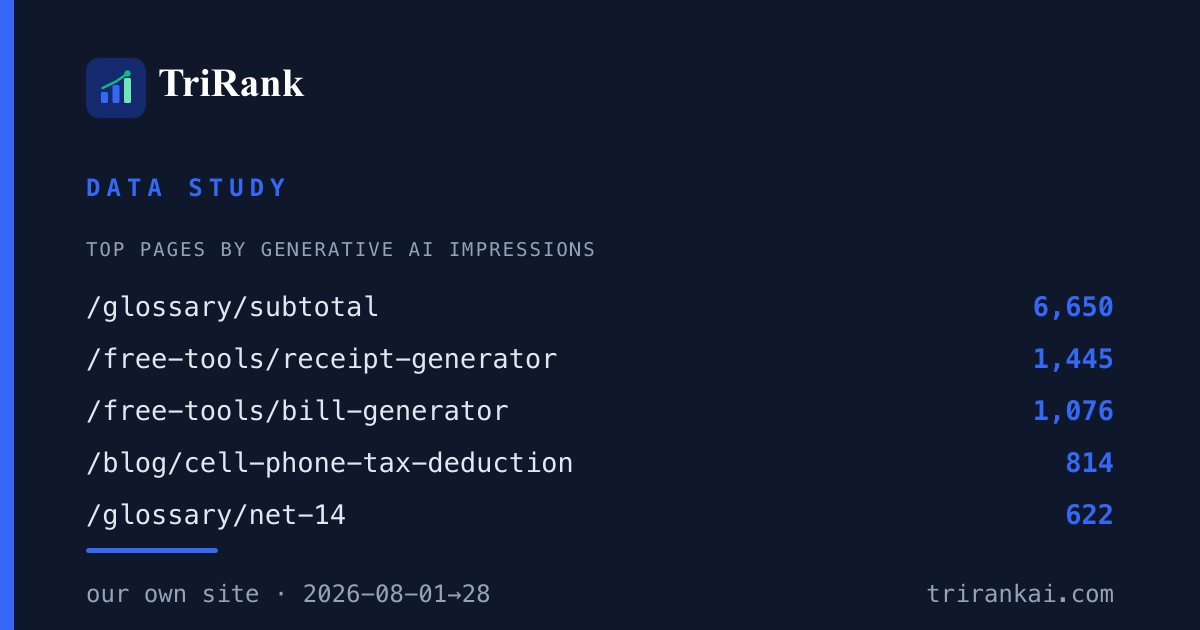
Top pages by generative AI impressions
The engine columns below come from different vendors, and the mapping is not one vendor per column. aio is a legacy key name and means Gemini plus Google Search grounding, not the AI Overview product, wording copied from our own schema comment (dataset L110). google_aio is the actual AI Overview — read off a live Google SERP by DataForSEO's SERP API rather than fetched by us, through serp/google/organic/live/advanced (queryGoogleAioCitation, src/geo/google-aio.ts). ai_mode is Google's AI Mode tab, which we read through that same vendor. The three Google surfaces are never merged, because the point of a third engine is seeing them disagree.
Rows are the 30 highest-impression pages in the export, cut at 94 (dataset L137–L166 of the full 257-row table).
Footnote on the chatgpt column. Under the matching rule our working note uses, that column is 0 on all 257 rows, and the zero is a fact about URL shapes, not about ChatGPT. In this window ChatGPT cited 7 distinct URLs on the site, all 7 carrying ?utm_source=openai; no other engine attached one (dataset L126, dataset L129). Our normaliser keeps query strings deliberately and Google reports clean URLs, so those rows cannot match. The column above uses the de-parameterised reading, under which 3 of the 7 match pages in the export (dataset L129), one being /free-tools/bill-generator inside this top 30 (dataset L95, dataset L139). Switching readings leaves summary figures ① and ③ unchanged (dataset L463–L467).
What the two datasets say together
Three things, and only three.
Every page our Google-surface engines cited turned up in Google's own report. google_aio cited 10 pages in the window, of which 10 appear among Google's 256 distinct pages, leaving 0 outside (dataset L63). For ai_mode the figures are 8, 8 and 0 (dataset L69). Both of those engines read Google's live surfaces, and they agree with Google's own export on every page.
Our 5 queries landed on 20 of the 257 pages. Across every engine on the sweep's roster it cited 34 page-URLs, 20 of them in Google's export (dataset L75). That overlap is bounded by the query set, not by the site, so 20 describes scope rather than grade. Run the same idea on your own property with our free AI visibility audit and the caveat travels with it.
Google's report gives neither queries nor clicks; ours gives queries and citations. Google can say a page appeared inside a generative AI feature but not what was asked. Our sweep starts from the query, so it names the prompt that produced a citation and the URL the engine returned, across engines Google does not report on at all. If you are comparing tools that track this, we keep an honest rundown of the alternatives.
What we cannot do with this
Quite a lot, and it is worth being specific.
We cannot make a causal claim in either direction. Two systems observing the same page is agreement between measurements, not evidence that one produced the other, and nothing here separates those.
We cannot generalise beyond this property. One site, one 28-day window (GSC export 2026-08-31, sheet Filters), one export read on one day, five tracked queries.
We cannot say anything about the pages our sweep did not reach. With 5 queries against 257 pages (dataset L34, dataset L13), the sweep's silence on a page carries no information; it is the expected consequence of the denominator, and reading it as a finding would be the easiest mistake to make with this table.
And we cannot resolve the two arms of our own measurement into one number. Our citation data has a primary arm, the full list of source URLs an engine returned, and a secondary arm, the single URL a probe recorded as chosen. They disagree on 18 page-engine combinations, all in the same direction, primary reading 1 and secondary 0 (dataset L402, dataset L425). That one-directional pattern is falsifiable, since scrambled data would disagree both ways, and it points at the arms answering different questions rather than at a fault. We publish the 18 rather than quietly taking the union.
Sources
- The GSC export cited above as GSC export 2026-08-31: gsc-ai-features-eonebill-2026-08-31.xlsx, generated 2026-08-31, window 2026-08-01 to 2026-08-28, sheets Chart / Pages / Countries / Devices / Filters. Published byte for byte as we read it.
- The working note cited above as dataset L<n>: eonebill-gsc-ai-x-engines-2026-08-31.md, a production read of the same property and window taken 2026-08-31, carrying the full 257-row table, both denominators, and the matching rule with its known defect written out. One line of it is redacted and this is that disclosure: the site row's internal database id on line 33 is replaced by an equal-length string of x characters, so the line numbers cited above all still point where they did. Nothing else in the file differs from the copy we worked from.
FAQ
What does Google's generative AI features export actually contain?
For this property, one metric and four dimensions. The export has five sheets — chart by day, top pages, country, device, and the filters that were applied — and every one of them carries exactly two columns, where the metric column is impressions (GSC export 2026-08-31, sheets Chart / Pages / Countries / Devices / Filters). There is no clicks column and no query sheet at all. So the report tells you that a page was shown inside a generative AI feature, and it does not tell you what someone asked to get there, or whether anyone clicked.
Why do the two impression totals in the same export disagree?
Because one of them is not additive. Summing the page sheet gives 18,165 and summing the daily chart gives 17,940, a gap of 225. Neither side undercounted: the country sheet and the device sheet also sum to 17,940, so three separate dimensions agree on the same total and only the page dimension runs high. A single impression can land on more than one page, which makes the page dimension non-additive by construction (GSC export 2026-08-31, sheets Pages / Chart / Countries / Devices). The figures in our table are the raw page-dimension values, with nothing apportioned.
Why is the ChatGPT column mostly zero when ChatGPT did cite the site?
It is a URL-shape artefact, not a statement about ChatGPT. In this window ChatGPT cited 7 distinct URLs on the site and all 7 carried a ?utm_source=openai tracking parameter, while no other engine attached one. Our matching rule keeps query strings on purpose, because ?page=2 really is a different page — and Google reports clean URLs. So the two sets cannot line up on those rows (dataset L126, dataset L129). Reading the strict column and the de-parameterised column side by side, the site-level summary figures do not move at all.
Does a small overlap between the two datasets mean the sweep is weak?
No, it means the two measurements have different scopes, which is why the denominators come before the table. Google reported 257 rows for this property across 28 days. Our sweep in that same window tracked 5 queries over 8 scan days, so the pages our probes can possibly reach is bounded by what those 5 queries surface. An overlap of 20 pages is what that scope produces (dataset L13, dataset L34, dataset L75); it is not a score, and it would be wrong to read it as one.
What can this comparison not tell you?
Anything causal, and anything about another site. Two independent measurements agreeing on a page does not establish that one caused the other, and nothing here supports a claim about how long anything takes or what would happen elsewhere. It is one property, one 28-day window (GSC export 2026-08-31, sheet Filters), one export read on a single day — and the site in question is our own, which is exactly why the denominators are printed before the table rather than after it.
Footnotes
-
Google Search Central: AI features and your website, read October 29, 2026. General documentation describes AI features within Web performance; this is not evidence of universal access to a separate report. ↩ ↩2
-
Original dated case evidence, live URL rechecked October 29, 2026; underlying export/read dated August 31, 2026. This draft collected no new property performance data. ↩ ↩2 ↩3
-
Search Console Performance report documentation, read October 29, 2026. Metric, grouping, export, and unavailable-value context matters. ↩ ↩2 ↩3
-
TriRank methodology, read October 29, 2026. Engine interfaces and failure states remain part of interpretation. ↩ ↩2
Author

Categories
Free tools for this
Related reading
More Posts
Self-Hosting Your SEO Stack: What It Actually Costs
Open-source SEO tools are having a moment, and self-hosting one is a real option. Here is the honest arithmetic: metered data fees, maintenance, a history that starts at zero, and one upstream you do not control.
42% of Brands AI Knows By Name Vanish When You Ask for Alternatives
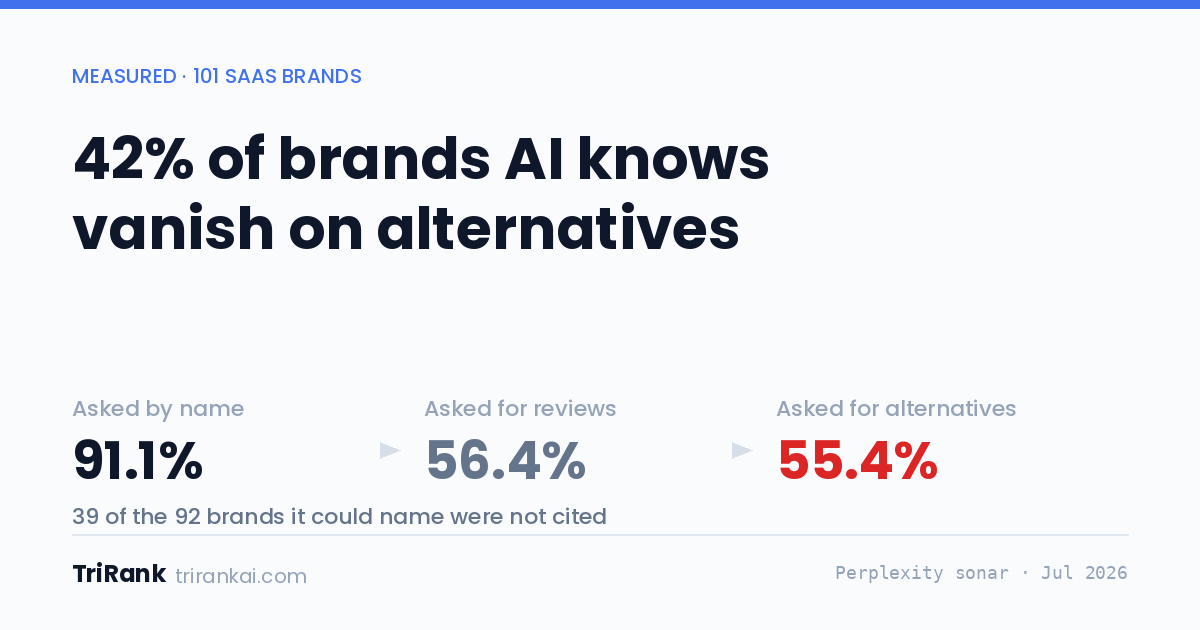
AI engines name 91% of SaaS brands asked directly. Ask the same engine for alternatives in that category and 42% of them disappear. Measured across 101 brands.
High Domain Rating Buys You Nothing in AI Answers
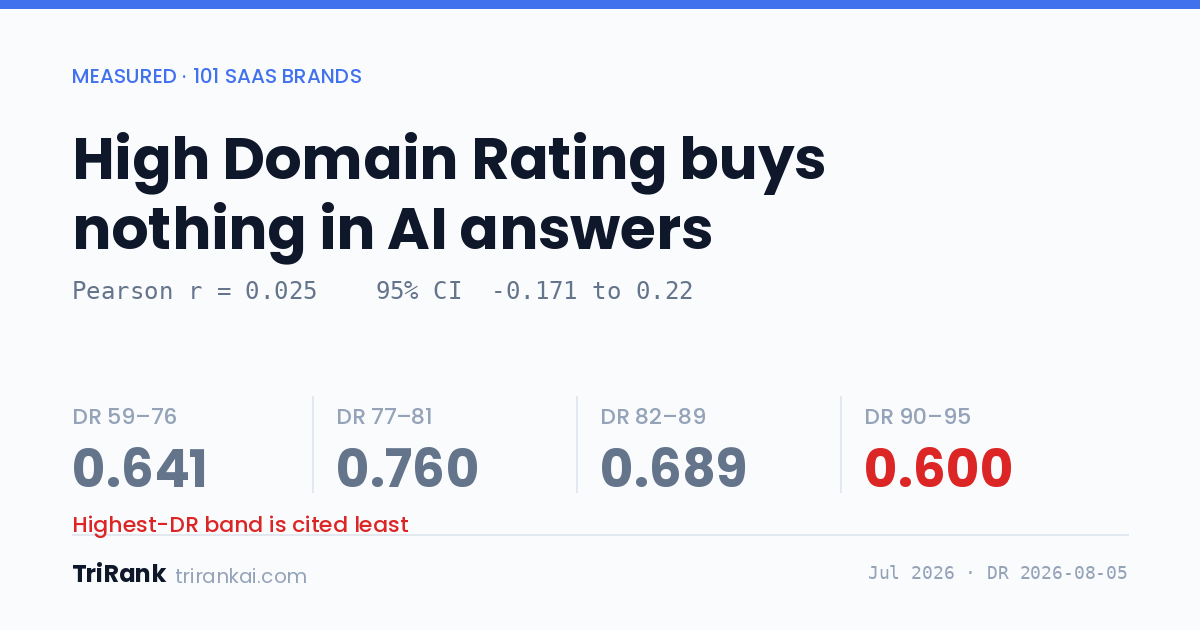
We crossed Ahrefs Domain Rating with AI citation rates for 101 SaaS brands. The highest-DR band is cited least often. Here is the data and its limits.
Newsletter
Join the community
Subscribe to our newsletter for the latest news and updates